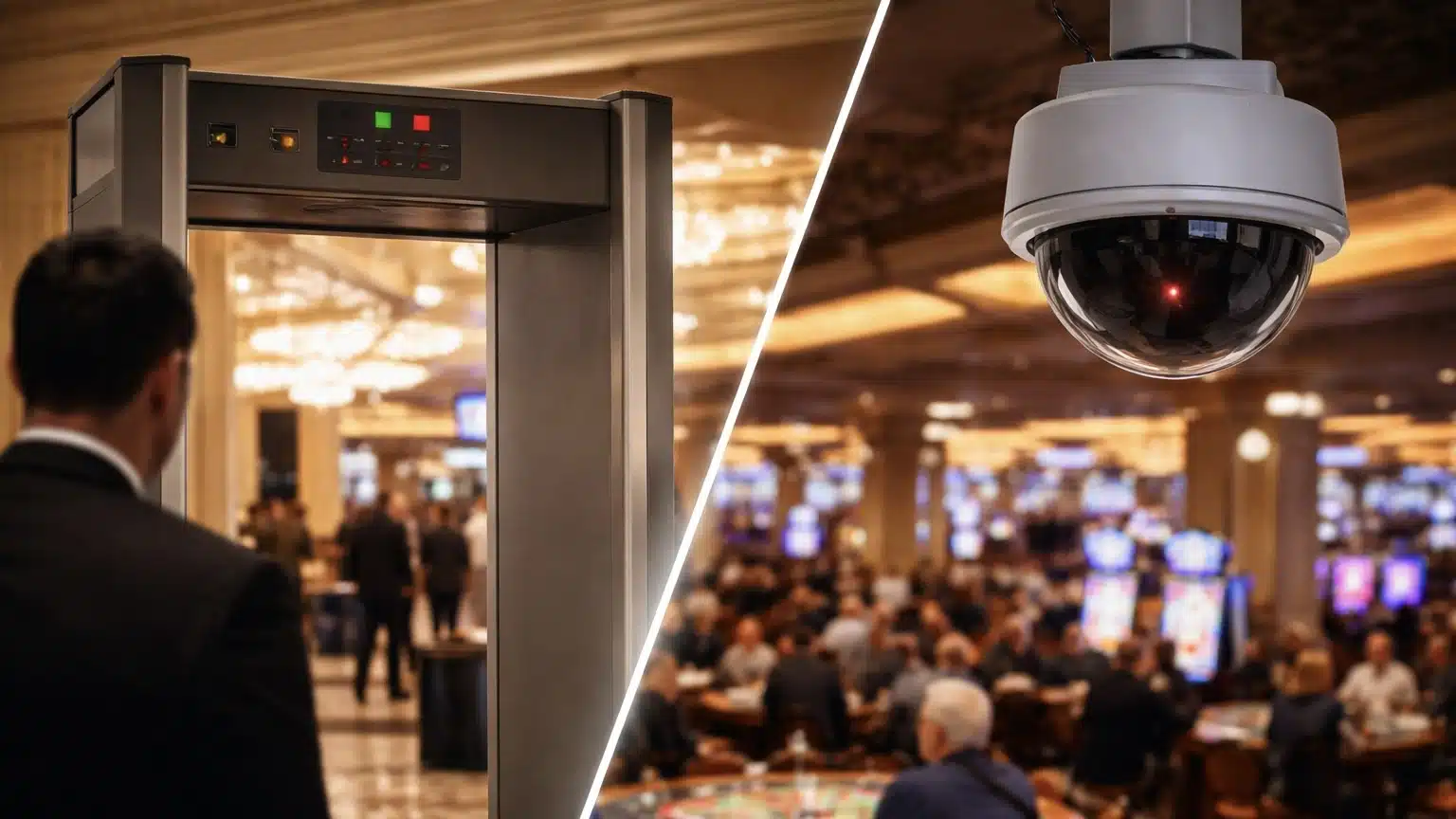
Casino weapon identification in 2026 encompasses both active screening technologies at entry points and passive AI-powered video surveillance operating throughout properties. The shift from reactive, labor-intensive manual screening to proactive, AI-driven detection marks a fundamental change in how gaming venues protect guests and assets. Modern weapon identification systems in casinos may help lower liability and potentially reduce insurance rates through the improvement of safety measures.
Casinos face unique security challenges: crowded gaming floors operating 24/7, significant alcohol service, large cash volumes in cages and count rooms, and major events drawing thousands of visitors through multiple entry points. Following high-profile incidents at US gaming venues, many casinos and entertainment venues have accelerated the adoption of security technologies that can detect potential threats without degrading the customer experience. These security measures are designed to protect customers while ensuring their comfort and peace of mind.
This guide provides casino operators, surveillance directors, and security leaders with actionable strategies for implementing AI gun detection, integrated cameras, analytics platforms, and guest-centric policies that enhance safety while maintaining the luxury atmosphere guests expect. Modern security systems can blend seamlessly into the casino environment, preserving the ambiance and ensuring that security remains unobtrusive.
Key Takeaways
- AI weapons detection can improve both safety and the experience of guests. It adds a quiet but important layer of security inside and outside of casinos.
- The ability to respond to and prevent incidents improves when weapons detection, access control, surveillance analytics, and VMS platforms are used together.
- For implementation to be successful, both the use of technology and the use of policies, training drills, and procedures for managing change must be in place.
- AI weapon identification works best when it is used with human verification in security operations centers. This keeps people involved at important decision points.
What Tools Are Used for Casino Weapon Identification?
Besides the human element of security guards manually searching individuals, there are three main types of technology used for finding weapons at casinos: concealed, visual, and audible weapons detection.
Concealed weapons detection technologies are the most traditional tools used at casinos. At the base level, this includes metal detectors (i.e., walk-throughs and handhelds) that use electromagnetic fields to identify any concealed metal objects. Recent advances in concealed weapons detection have led to the development of weapon scanners, which can better distinguish between harmful and non-harmful items.
Visual weapons detection tools use AI to scan live footage for firearms or other specific weapons that are drawn. These can be deployed in cameras across a casino, both indoors and outdoors, and seek to shorten the time between detection and response.
Audible weapons detection, like gunshot detection, uses audio to locate the specific area a gun has been fired so that responders can have a more targeted intervention. These are less commonly used in casinos.
From Traditional Screening to AI Weapon Identification in Casinos

The Drawbacks of Traditional Weapons Detection in Casinos
Traditional screening methods like walkthrough metal detectors, handheld wands, and bag checks have served casinos for decades, but they create significant operational challenges that often clash with modern expectations. What are the limitations of traditional weapons detection approaches in casinos?
- Problems with operations: During busy times, such as Saturday night shows or big tournaments, long lines form at casino entrances as patrons wait to be screened. Guests wait in line instead of on gaming floors, which means that each available seat loses money.
- Experience limitations: Metal detectors and pat-downs go against the resort-style look that casinos have worked hard to create for decades. Guests may associate metal detectors with courthouses and airports. This can possibly impact NPS scores and return visits.
- Detection problems: Older systems can set off alarms for things that aren’t dangerous, like keys, phones, belt buckles, and chip cases. They may have trouble telling the difference between a hidden gun and a metal vape or phone. This can lead to high false-positive rates.
- Staffing pressure: Traditional checkpoints require multiple security personnel per lane, raising labor costs in 24/7 operations where hiring and retention remain difficult.
Automating Detection with Artificial Intelligence
In 2026, AI is being used to analyze sensor or video data in real time to identify firearms, other weapons, and anomalies with configurable confidence thresholds.
There are two main categories of AI detection used in this security context, each serving different functions. First, there are AI-powered screening portals that can be placed at entrances and replace or augment traditional metal detectors. Second, AI video analytics installed on existing IP cameras throughout properties can scan footage and detect strange behaviors, like loitering, and brandished or visible guns.
This use, visual AI gun detection, is increasingly being chosen by gaming and entertainment venues due to its enabling of faster and more discreet entry screening that allows guests to keep their phones, wallets, and bags. Additionally, unlike stationary walk-through detectors that are stuck at the entrances, it can be deployed in cameras throughout the premises, including in hallways, lobbies, parking lots, and on the gaming floor. Most violence doesn’t start or stay at the front door; the ability to detect a handgun drawn during a dispute at a blackjack table or a rifle being carried out of a parking garage is a major benefit of this technology.
AI gun detection is probabilistic, and it is most successful with human verification. Security teams in surveillance rooms should evaluate alerts before dispatch. This helps reduce unnecessary responses while maintaining situational awareness.
How do AI Cameras and AI Gun Detection Work?
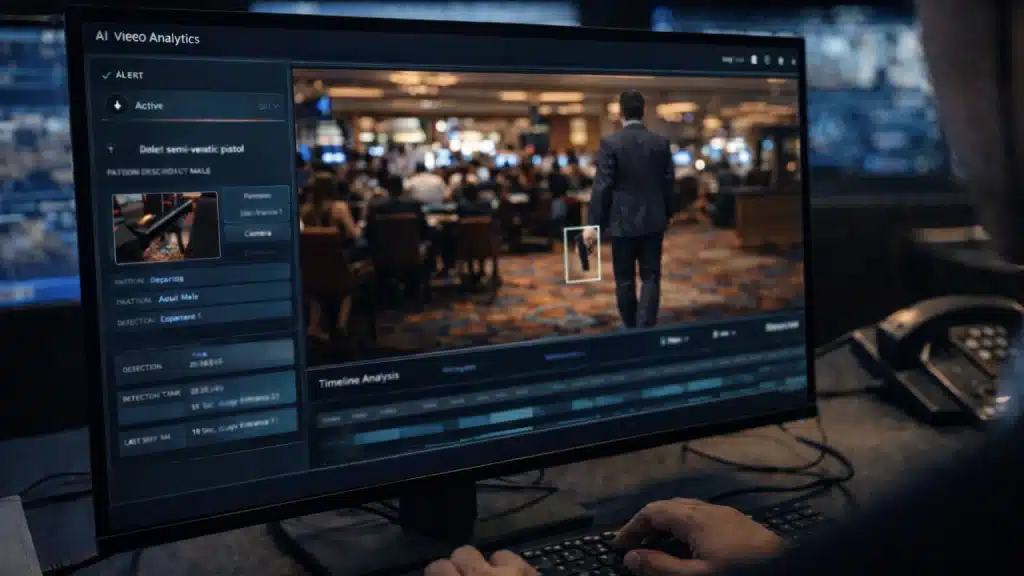
Casino visual AI weapon identification hinges on computer vision. This is powered through AI training, using deep learning models (like convolutional neural networks, or CNNs) or data-centric practices to analyze annotated images and video frames of weapons in diverse conditions. This enables real-time shape recognition, pattern matching, and contextual analysis even amidst crowded, dynamic environments where security teams need split-second accuracy. How does this compare to another AI weapons detection method?
Video-Based Detection Workflow:
- Live camera streams from casino floors, cage lines, poker rooms, and garages feed into an AI analytics engine.
- Models scan each frame searching for shapes and textures consistent with firearms, like barrel length, grip angle, or muzzle flare.
- When confidence exceeds the designated threshold, the system creates an alert with the camera ID, time, and exact location.
Screening Portal Workflow:
- Guests walk naturally through lane-based gateways with concealed sensors and overhead 3D or thermal cameras.
- Embedded AI analyzes electromagnetic field disturbances and visual cues to differentiate weapons from benign objects.
- The system highlights the person and approximate weapon location for targeted secondary screening.
To maximize security, visual AI gun detection (video-based) can be paired with walk-through screening, like concealed weapons scanners. Scanning portals may be used at the door to try to prevent weapons from entering a gaming floor, and in the case that a gun does make it inside, AI gun detection can detect it within seconds of it becoming visible.
Any detection system used in casinos must be able to run efficiently. Touchless screening technologies let guests walk through entrances without having to take off their shoes or empty their pockets, which fits in perfectly with the high-end feel of gaming floors and entertainment venues. This not only makes things safer, but it also keeps guests happy by cutting down on wait times and interruptions.
Technical Considerations
When using visual AI weapon identification systems, there are some things to keep in mind. Cameras should be optimized to have wide dynamic range (WDR) and low-light imaging capabilities to ensure maximum visibility in complex casino environments. Edge hardware (GPU-enabled appliances on-site) can limit latency and avoid network dependency. Models should update periodically to recognize new firearm designs and concealment methods.
Performance metrics to think about include detection rates for handguns and long guns, false alarm rates per camera per hour, and typical alert latency (the time from gun appearance to alert).
Security Infrastructure and Considerations for Weapon Identification
A robust casino security system infrastructure is the backbone of effective casino security, ensuring the safety of guests, employees, and assets in an environment that never sleeps. As casinos evolve, so too must their security measures, especially when it comes to weapon identification. Relying solely on traditional metal detectors is no longer sufficient; these systems often slow down the screening process, generate excessive false alarms, and disrupt the guest experience during peak hours.
Modern systems for finding weapons are a big step forward. These high-tech security systems use a mix of smart sensors and AI algorithms to quickly and accurately find weapons like guns and knives. By providing real-time alerts to security personnel, these systems enable a rapid response to potential threats, helping to mitigate risks before they escalate. But these tools are only as strong as the security system they’re part of.
Layered Casino Security: Adding Weapon Detection to Existing Systems
Layered security systems use many different tools that work together to secure all aspects of a casino. This makes the environment safe because there is no one point of failure that could bring down the whole security program.
Layers in a typical casino:
- Outer perimeter: parking lots, garages, shuttle drop-offs, and loading docks.
- Entry points: main entrances, VIP access, staff doors, and event-space doors.
- Interior zones: gaming floor, cash cages, count rooms, high-limit areas, and back-of-house corridors.
How can AI weapon identification be used at each of these layers? In the outer perimeter layer, cameras in parking structures can detect weapons before visitors reach the front doors. At entry points, AI screening gateways can integrate with access control turnstiles and player card kiosks. Inside, analytics on surveillance cameras can be used to detect weapons that bypassed entry or were retrieved from vehicles.
Integration with Existing Systems
Integration is another key feature of a modern security program. By combining weapons detection with access control, alarm systems, and emergency notification systems, workflows can be automated to improve emergency response. Video Management System (VMS) integration automatically displays relevant camera feeds when alerts trigger. Access control linkage can temporarily lock staff-only doors upon confirmed threats. Mass notification and radio dispatch integration push alerts to security radios and mobile apps.
A comprehensive security solution involves each part working together to enhance threat detection and response. However, some solutions focus specifically on gun detection and do not use other technologies such as facial recognition or additional AI methods that may infringe on privacy rights.
Establishing Incident Workflows
When each element of a casino security system is integrated with the others, incident workflows are made easier. Successful workflows should include:
- Alert triage in SOC with verification by trained operators.
- Predefined playbooks for different scenarios (i.e., for a visible handgun near a cage, an automatic rifle being carried out of a garage entrance, an escalating conflict between two patrons, etc.)
- Dispatch protocols connecting floor security personnel and local law enforcement.
Each of these can help to improve responses to incidents, big and small.
Leveraging Security Data and Analytics for Proactive Threat Detection

Weapon identification systems can generate rich data connecting camera analytics, access logs, and incident reports into actionable intelligence.
Data Generated:
- Timestamped records of every alert, including camera ID, location, threat type, and operator disposition.
- Guest throughput statistics: guests per minute, peak times, average secondary screening duration.
Proactive Applications:
- Identify high-risk entrances or time windows (late-night weekends, specific events).
- Track false-positive trends and calibrate sensitivity accordingly.
- Adjust staffing levels and patrol routes based on recent alert patterns.
- Update weapons policies after data shows repeated attempts to bring specific item types onto casino property.
Recommended Analytics Views:
- Daily and weekly heat maps showing where and when alerts cluster.
- KPIs like average response time from alert to on-scene security presence.
- Trend analysis comparing incidents across properties or time periods.
Protecting the Guest Experience While Improving Weapon Detection
Casinos compete on atmosphere; security measures must protect patrons while remaining nearly invisible in public-facing spaces.
Frictionless screening can be enhanced using AI gun detection technology. Unlike traditional methods, guests can walk at a normal pace through AI gateways without emptying their pockets or removing bags. With visual identification (installed on cameras), there is minimal visible hardware; security cameras, which are already in use, can have customizable enclosures that match casino design aesthetics, and the visual AI gun detection technology runs invisibly to patrons in the background.
Communication strategies should be established to help visitors understand security protocols, both routinely and during an incident. Clear signage explaining advanced security protects guests without recording unnecessary data. Front-of-house staff should be trained to answer questions confidently and calmly.
Privacy considerations should be inherent in any new technology, plan, or protocol. Systems must be configured to avoid storing guest images longer than incident reviews require. Facial recognition technology, if used for banned patrons, requires compliance with local regulations and transparent data governance.
Measurable outcomes can and should be used to guide future investments. For example, reduced wait times during large concerts and tournaments, or fewer invasive bag checks and pat-downs compared to legacy security approaches.
Implementation, Training, and Policies for Casino Weapon Identification
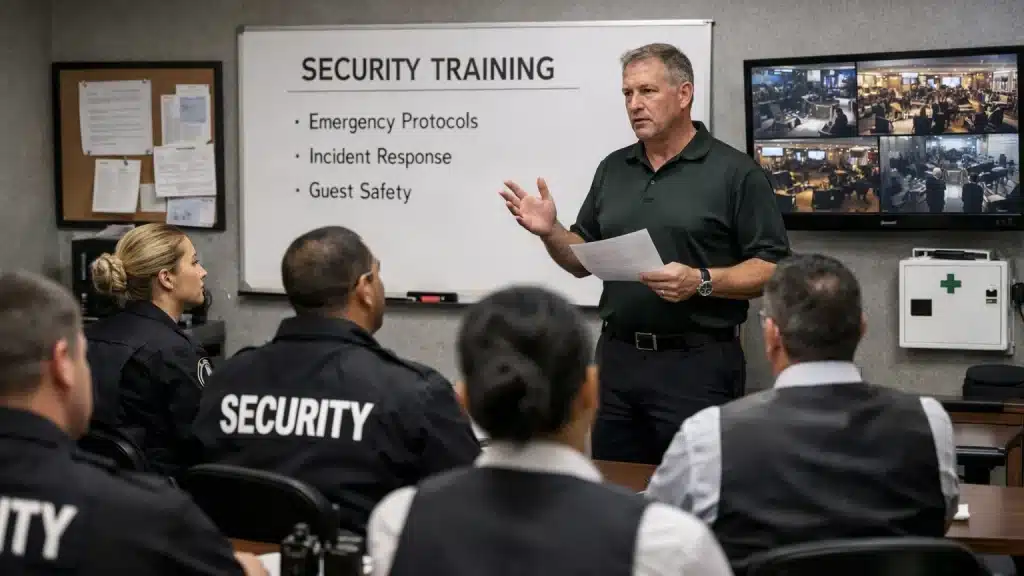
Technology succeeds only when backed by procedures, policies, and comprehensive training.
Phased implementation
With any new technology, a phased implementation can be a strong choice. For example:
- Phase 1: Pilot at 1-2 entrances with a subset of cameras for 60-90 days.
- Phase 2: Expand to all public entrances after analyzing pilot data and tuning thresholds.
- Phase 3: Formalize SOPs and roll out training across departments.
This will help to understand how to best utilize casino weapon identification technology for your specific location.
Training components
Technology is only as strong as the people using it. Training (specifically, role-based training) is essential for implementing weapons detection tools.
Surveillance staff should be trained on interpreting alerts, verifying detections, and avoiding confirmation bias, and security officers need to learn approach tactics, de-escalation, and incident command structures. Hotel, F&B, and gaming supervisors who are cross-trained in lockdown procedures, active shooter protocols, and first aid are the most prepared for unpredictable situations that require more than a response from security teams alone.
Policy updates
Regularly update weapons policies reflecting new capabilities, including rules for off-duty law enforcement and VIP bodyguards. Define escalation levels (non-threatening visible weapon vs. active threat) with matching procedures.
Compliance considerations
To stay compliant with local, state, tribal, and federal regulations, always coordinate with law enforcement and gaming commissions before deployment. Review data retention, video recording, and biometric regulations for the jurisdiction and adjust casino policies accordingly.
Choosing the Right Casino Weapon Identification Solution

Evaluation should balance detection performance, operational efficiency, and total cost of ownership. When choosing a system or technology, consider:
- Detection performance: How accurately can the technology detect handguns, long guns, and knives (all, or technology-specific)? How is the performance in crowded, high-glare casino environments?
- Throughput capacity: What is the maximum number of guests per hour per lane for screening solutions? What is the processing capacity per camera stream for video analytics?
- Integration capabilities: Does the tech allow for native integration with existing VMS, access control, and incident management platforms? Does it utilize open APIs for future integration with license plate recognition, visitor management, or loyalty systems?
- Operational factors: What is the ease of deployment in 24/7 venues with minimal disruption? Is there flexibility to reconfigure lanes for events and seasonal surges?
- Support and service: Is there 24/7 support availability and remote health monitoring? On-site training and refresher courses for employees?
- Total cost of ownership: Consider hardware, software licenses, on-prem compute, and recurring support. Are there potential savings from reduced labor and lower incident/insurance risk?
To learn more about how different types of weapon identification technologies compare to each other, click here.
The Future of Casino Weapon Identification
Casino weapons detection in 2026 requires blending AI detection, integrated analytics, and thoughtful policies into cohesive security operations. The proactive solution of layered weapon detection can coexist with—and enhance—a premium guest experience when implemented strategically.
Casino executives and surveillance directors should assess current gaps and plan modernization roadmaps, looking forward to a future where the experience is enhanced, and not limited, by security.
Iterative improvement based on security data enables the ongoing refinement of detection thresholds, staffing models, and response procedures. As threats evolve, continuous advancement in AI and analytics will shape next-generation casino security, creating entertainment venues where guests feel safe without experiencing the friction of traditional security measures.
To learn about how Omnilert’s visual AI gun detection can be implemented in casino settings, click here.
Frequently Asked Questions (FAQs)
![]() What is casino weapon identification?
What is casino weapon identification?
Casino weapon identification encompasses the procedures and technology involved in detecting firearms, guns, and other weapons that are brought into casinos. This includes concealed (weapon scanners and metal detectors), visual (AI gun detection), and audible (gunshot detection) weapons detection systems.
How is AI gun detection different from metal detectors?
Traditional metal detectors will alarm on any metal object, including phones, keys, and belt buckles, creating high false-alarm rates. AI systems analyze object shapes and patterns to differentiate weapons from innocuous items, reducing false positives while improving throughput. Additionally, scanners and metal detectors are isolated to main entrances, whereas visual AI gun detection technology can be installed on cameras throughout the casino premises.
How does weapon identification impact guest privacy?
Systems can be configured to focus solely on object detection without capturing or storing facial images. Routine surveillance footage is often retained for only 30-90 days. Where facial recognition is deployed for banned patron enforcement, casinos must comply with local regulations and maintain transparent data governance policies.
How quickly can AI weapon detection alert security teams?
Video-based gun detection typically generates alerts within seconds of a weapon appearing in frame, combining AI processing time with operator verification. To learn more about the detection-verification-response workflow, click here.