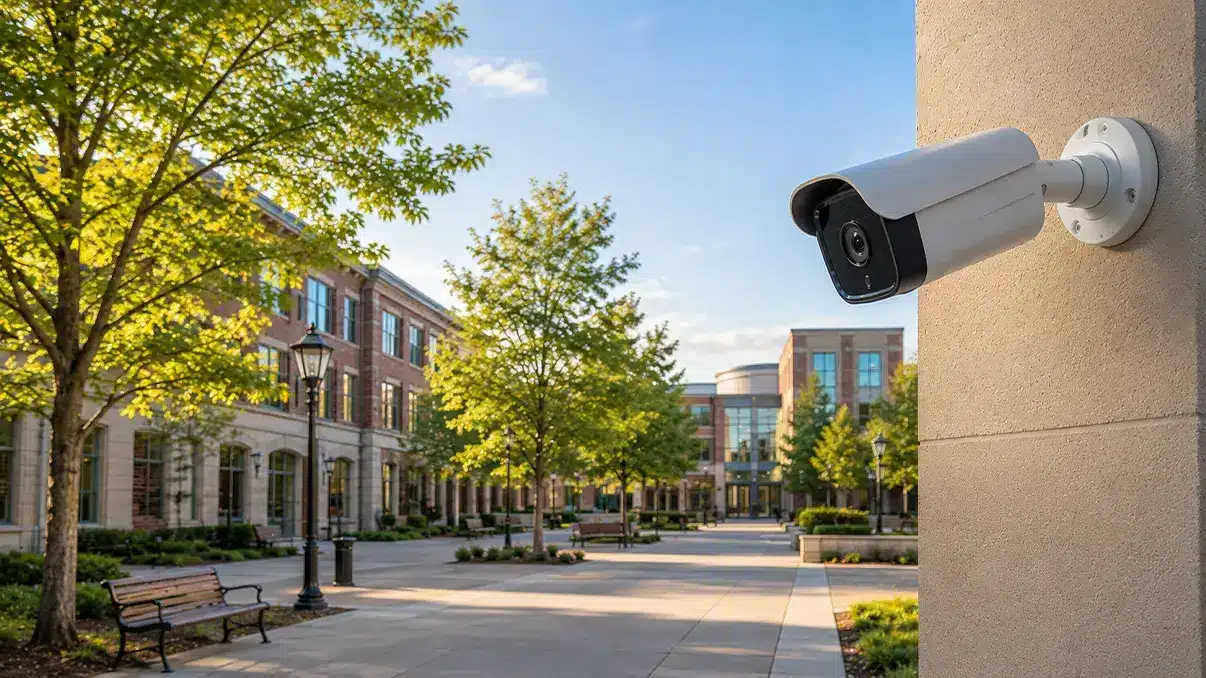
Outdoor spaces are some of the most challenging environments to protect. Parking lots, courtyards, walkways, perimeter lines, remote sites, and venue approaches are open by design. People move freely, entry points are not always controlled, and traditional screening methods often are not practical or scalable.
Yet these outdoor areas may be where risk begins.
In our recent webinar, Outdoor & Large-Area Coverage: Visual AI Gun Detection Where Traditional Screening Can’t Be Deployed, Omnilert experts Ara Bagdasarian, Eric Polovich, and Chad Green explored how organizations can extend proactive threat detection beyond building entrances and into the open spaces where a visible firearm threat may first appear.
The session focused on a practical question: How can organizations detect and respond to firearm threats across environments that were never designed to be tightly controlled?
Why Outdoor Spaces & Large-Area Environments Are Harder to Protect
Many security strategies are built around controlled environments: entrances, lobbies, checkpoints, and interior spaces where people pass through predictable areas. But real-world campuses and facilities are often much larger and more open.
Schools, hospitals, corporate campuses, retail centers, stadiums, manufacturing sites, and government facilities all face a similar challenge. People move between buildings, parking areas, walkways, loading docks, open courtyards, and other public spaces throughout the day. These areas are important to everyday operations, but they are difficult to monitor consistently.
In the webinar, Omnilert made an important point: simply having cameras doesn’t mean you have real situational awareness. Many organizations already have outdoor cameras in place, but they’re often used only after something has happened, to review footage, piece together events, or support an investigation. That’s very different from having a system that can actually help you spot a threat in the moment and act on it. They help teams understand what happened, but they may not be optimized to detect a threat in real time.
That difference matters. When a visible firearm threat appears outside a building, the goal is not simply to record the event. The goal is to detect the threat early enough to initiate a response before the situation escalates.
The Pre-Attack Window: A Critical Opportunity for Earlier Detection
One of the most important concepts discussed in the webinar was the pre-attack window.
Active shooter incidents are often viewed through the lens of the first shot fired. But in many cases, the threat begins earlier. An attacker may arrive on site, retrieve a weapon, move through a parking lot or walkway, approach a building, and enter a target area before violence begins. As our experts emphasized, this creates a critical window of opportunity for earlier detection and response.
If a visible firearm can be detected during this early stage, security teams may be able to start a response sooner. That can mean alerting the right people, securing doors, activating emergency procedures, sharing critical details with first responders, and giving everyone a little more time to move out of harm’s way.
This is where visual AI gun detection plays a different role than traditional surveillance. Rather than waiting for someone to notice a threat on a live camera feed or reviewing footage after the fact, visual AI can monitor camera streams for visible firearms and surface alerts when a potential threat appears.
In an emergency, seconds matter. Moving detection earlier in the timeline can help move the entire response earlier as well.
Outdoor Surveillance vs. Outdoor Detection: Why Camera Design Matters
A major takeaway from the webinar was that outdoor gun detection requires more than simply pointing a camera at a large area.
Traditional surveillance cameras are often designed to observe wide scenes. That may be useful for general visibility or later investigation, but detection requires enough visual detail for the system to identify a specific object.
In other words, the question changes from: “How much area can this camera see?”
to: “At what distance can this camera reliably detect a visible firearm?”
That shift is especially important for outdoor spaces, where wide fields of view, long distances, inconsistent lighting, weather, and camera quality can all affect performance.
The webinar covered several factors that influence detection readiness, including:
- Camera placement
- Field of view
- Pixel density
- Image clarity
- Lighting conditions
- Lens cleanliness and camera quality
As Chad Green explained during the session, pixel density plays a major role. As a person moves farther away from the camera, the amount of visual detail available decreases. A camera may still be recording the person, but the image may not contain enough detail for confident firearm detection. This is why outdoor deployments require intentional design.
Designing Outdoor Gun Detection Coverage Around Movement Paths
One of the most practical recommendations from the webinar was to design detection around how people move through an environment.
Instead of focusing only on the destination where violence might occur, organizations should consider the approach path. Where would a person arrive? Where might they park? Which walkways, entrances, or open spaces would they move through before reaching a building or gathering area?
By prioritizing these movement paths, organizations can shift from a reactive posture to a more proactive one.
For example, a parking lot may not be the final target area, but it may be where a threat first appears. A walkway may seem like a transitional space, but it may be where a visible firearm becomes detectable. A perimeter or remote outdoor asset may not have a staffed checkpoint, but it may still benefit from camera-based detection.
This approach helps organizations think beyond traditional screening points and consider where early awareness could make the greatest difference.
What “Detect, Verify, Respond” Looks Like in Outdoor Spaces & Large-Area Coverage
The webinar also walked through the operational workflow behind Omnilert Gun Detect.
The process begins when the AI spots a visible firearm on a camera feed. From there, the alert is sent to a human reviewer to confirm what the system is seeing. Keeping a human in the loop is extremely important. They can add context, rule out false alarms, and help guide smarter, more confident response decisions.
Once a threat is verified, the system can trigger the response workflow defined by the organization. That may include:
- Notifying key staff
- Sending multi-channel alerts
- Initiating emergency communications
- Triggering integrations with other safety systems
- Sharing images, video, location, and metadata
- Escalating to first responders
- Activating actions such as access control or lockdown procedures
The goal is not detection alone. The goal is to turn detection into action quickly. That’s why interoperability is critical. When gun detection connects with emergency notification, access control, video management, alarms, and other systems, organizations can coordinate responses more effectively.
Extending Outdoor Coverage with Edge, 5G, and Motion-Directed PTZ Deployments
Outdoor spaces and wide-open areas come with their own set of challenges. Some spots don’t have reliable network access, and others are temporary, remote, or simply too large to cover with fixed cameras alone.
The webinar walked through several ways to work around those limitations, including edge-based processing, 5G connectivity, solar- or pole-mounted units, and motion-directed PTZ cameras. One example was a fully self-contained unit that mounts on a light pole and uses whatever power is available, with battery or solar options when needed. When you add 5G, it becomes a flexible option for parking lots, outdoor events, festivals, construction sites, and other big open spaces where traditional infrastructure just isn’t there.
For large outdoor spacess, that level of detail matters. Intelligent camera movement and zoom help maintain the clarity needed to identify a visible firearm at greater distances.
Key Takeaway: Outdoor Spaces & Large-Area Security Requires Intentional Detection Design
Outdoor spaces and large-area environments are inherently difficult to secure. They are open, dynamic, and often lack controlled entry points. But with the right strategy, existing and new camera infrastructure can become part of a proactive detection layer.
Visual AI gun detection can help organizations identify visible firearm threats earlier, initiate verification and response faster, and extend coverage into areas where traditional screening may not reach.
For teams responsible for campuses, parking lots, event venues, remote facilities, perimeters, and other open spaces, the opportunity is clear: move beyond passive surveillance and build a more proactive approach to outdoor threat detection. Watch the full on-demand webinar to learn how Omnilert visual AI gun detection can help close outdoor coverage gaps and support faster response across large, open environments.