In an emergency, location clarity can change the speed and quality of the response. If reports are incomplete, delayed or never made at all, responders may lose valuable time trying to understand where an incident occurred and what they are walking into.
The need for faster awareness remains urgent. In 2024, more than 44,000 people died by firearms in the U.S., and more than 200 people visited emergency departments for nonfatal firearm injuries on an average day. When shots are fired, every second matters. Gunshot triangulation can help identify where suspected gunfire occurred, giving responders clearer location information when time is critical.
That urgency is why gunshot detection technology has become part of public safety planning for cities, campuses, critical infrastructure sites and high-risk facilities. These systems are designed to detect possible gunfire, identify where it happened and send actionable alerts to the people responsible for response.
In this guide, you’ll learn how gunshot triangulation works, what affects its accuracy and what to consider before deploying a system. Whether you’re evaluating technology for a police department, managing campus security or simply trying to understand how modern public safety tools operate, this breakdown will give you the clarity you need.
What Is Gunshot Triangulation?
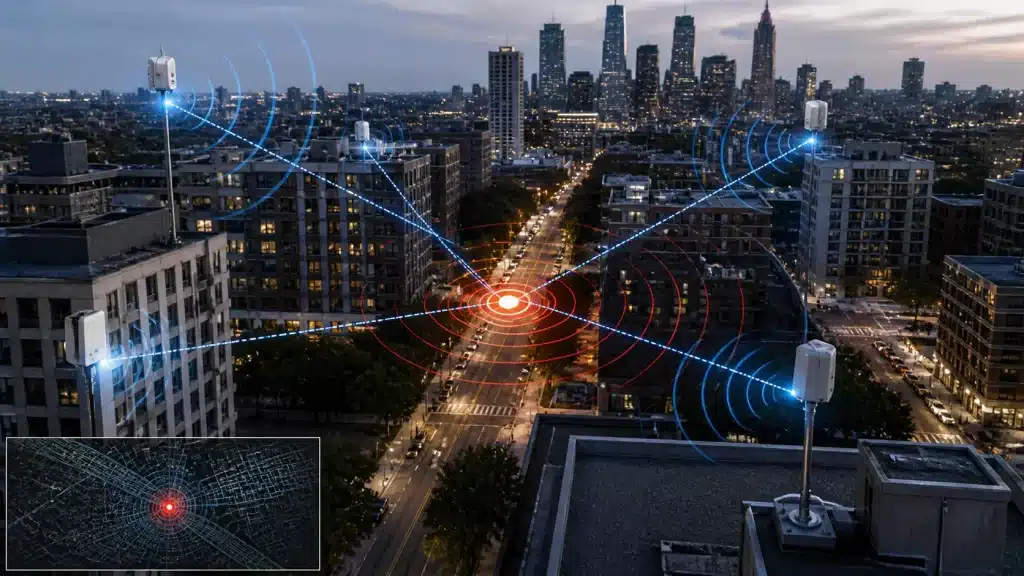
Gunshot triangulation is a way to pinpoint where a gunshot came from by using multiple sensors that detect the sound at slightly different times. When a gun is fired, the sound spreads outward in all directions, and each sensor picks it up at a different moment depending on its distance from the source. By comparing those tiny timing differences, and in some cases, angle data, the system can work backward to estimate the origin point on a map.
Although the process is often called triangulation, many systems technically rely on multilateration, which uses time differences between sensors to calculate the likely source of the gunfire. This approach is common in modern gunshot detection and gunfire locator systems, including public safety networks, security deployments and military counter-sniper applications. Some systems rely primarily on acoustic sensors and time-difference-of-arrival calculations, while others may integrate additional sensor types for confirmation or situational awareness.
One reason these systems are used is that many gunfire incidents are never reported through 911. In some studied cities, acoustic detection systems identified gunfire that did not generate a 911 call, suggesting that triangulation-based systems can help surface incidents that might otherwise go unnoticed.
How Does a Gunshot Triangulation System Work?
Understanding the basic physics behind triangulation helps you get a clearer sense of what the technology can and can’t do. At the simplest level, it all comes down to catching the exact moment a sound reaches each sensor scattered around an area and comparing those tiny timing differences.
When a gun is fired, sound travels outward and reaches each sensor at a slightly different moment. By comparing those arrival times, the system can estimate where the shot originated. Those sound waves move outward at roughly 343 meters per second in normal air. Because each microphone is sitting in a different spot, they all “hear” the shot at slightly different times.
The core measurement behind many gunshot triangulation systems is time difference of arrival, or TDOA. In simple terms, the system compares when the same gunshot reaches different sensors, then uses those timing differences to estimate where the shot originated. Later, we’ll look at the specific algorithms that turn those measurements into a map location.
System design also matters: sensor placement, spacing and environmental conditions all affect how accurately a system can calculate the source of suspected gunfire. Once a potential gunshot is detected, the system immediately starts crunching the sensor data and sends out location-based alerts so people can respond faster and with better information.
All of this hinges on incredibly precise timing. The sensors rely on GPS-synced clocks to stay aligned down to the microsecond, and those ultra-accurate timestamps are what make it possible to calculate exactly where the shot came from.
Gunfire Characteristics Relevant to Triangulation
Accurate gunshot triangulation starts with understanding what gunfire actually sounds like, and sometimes what it looks like, in real-world conditions. Not every shot produces the same acoustic pattern, and the environment can dramatically change what sensors pick up.
A gunshot usually has a couple of defining sound elements: the sharp muzzle blast and, if the bullet is traveling faster than sound, a ballistic shockwave. In busy urban areas, those sounds can bounce off buildings, pavement and other hard surfaces, creating echoes that complicate the audio. Different calibers also have their own acoustic signatures, so a .22 LR won’t sound the same as a 9×19mm, 5.56×45mm NATO or 7.62×39mm round.
Other factors can make detection even more challenging. Subsonic ammo and suppressors can soften or change the sound of a shot, especially over longer distances or in areas where sensors are spaced farther apart. Fully automatic fire adds its own challenge, creating rapid bursts that some systems may interpret as multiple separate shots.
Some detection systems also look for visual cues, like optical or infrared flashes from the muzzle, to help confirm that a shot actually happened. That extra layer is especially helpful indoors or at night, when audio alone can be harder to interpret.
Discriminating Gunfire from Other Impulsive Sounds
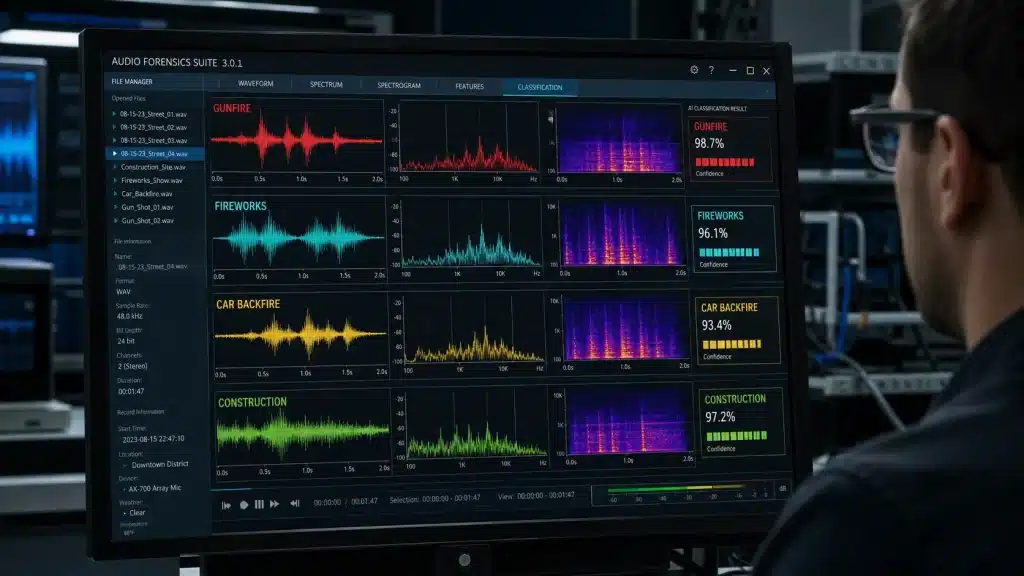
Reliable gunshot triangulation relies on accurate sound. The system has to know whether it’s hearing an actual gunshot or something that just sounds similar. If it can’t tell the difference between a firearm and fireworks, a car backfire or construction noise, it risks missing real incidents or sending alerts that don’t need to happen.
To make that distinction, detection systems look at things like the shape of the sound wave, the frequency patterns and how quickly the sound rises and fades. These details help the system decide whether a noise matches the profile of gunfire. Many modern systems also use machine-learning models trained on large collections of labeled audio to improve accuracy and cut down on misclassification.
Some setups add a pre-filtering step to weed out sounds that clearly aren’t gunshots before running the more complex location algorithms. In certain deployments, the audio tools can also link to nearby cameras, giving teams a quick visual check of the area where the sound came from and helping them respond with more context.
Core Gunshot Triangulation Methods and Algorithms
Once the system captures when each sensor heard the sound, the direction it came from, and how clean the signal was, it uses algorithms to estimate a location. Different gunshot‑triangulation systems use different techniques, and those choices affect how accurate, fast, and resource‑heavy the process ends up being.
One of the most common approaches is TDOA‑based multilateration. It looks at the tiny differences in arrival times across sensors, turns those into distance clues, and uses that to pinpoint the source. It can be very accurate when conditions are just right, but real‑world factors — things like sensor quality, background noise, and how complex the environment is — can still shape the results.
Some systems add angle‑of‑arrival (AOA) technology, which uses directional microphones or acoustic vector sensors to figure out the direction the sound traveled from. Others blend TDOA, AOA, and statistical filtering to get more reliable results in challenging places like busy downtown areas, campuses, or stadiums, where echoes and obstacles make sound harder to interpret.
Modern triangulation systems can run on embedded devices, edge hardware, or cloud platforms. They rely on extremely precise timing, often kept in sync with GPS‑disciplined clocks, so all sensors stay aligned and the system can calculate locations accurately. Many setups also run quality checks to throw out bad data, prioritize cleaner signals and create a confidence radius around the estimated location.
Edge processing gives the system another boost by filtering or analyzing audio right at the sensor before anything is sent upstream. That cuts down on bandwidth, reduces unnecessary processing and helps alerts move faster. In more advanced deployments, systems can even compare different acoustic signatures coming from different directions, which helps identify more complex situations like multiple shots or more than one possible firing point.
Sensor Configuration and Network Design
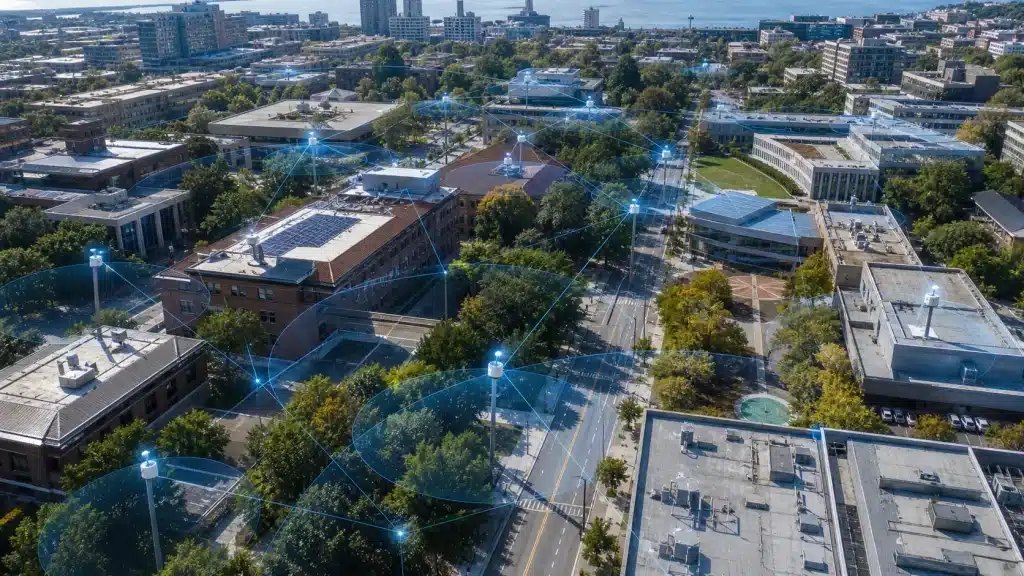
Sensor placement has a huge impact on how well gunshot triangulation works. If the network isn’t designed properly, you could end up with blind spots or accuracy issues that make the system unreliable in real-world use.
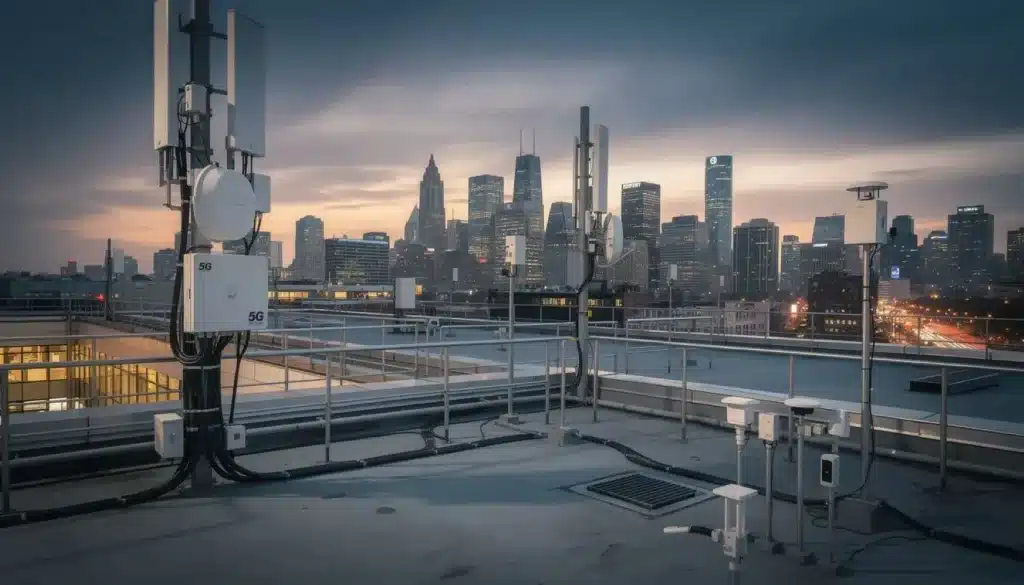
Outdoors, sensors are spread across the area and mounted on rooftops, poles, or other high spots. Getting them up high helps cut down on street-level noise and makes tampering harder. Indoors in places like schools, hospitals, airports or large campuses, sensors are placed in hallways, large rooms, atriums and other key areas where overlapping coverage improves both detection and location accuracy.
For triangulation to work, more than one sensor has to pick up the same shot. Three sensors are generally the minimum for calculating a location, but having more sensors in the mix usually improves accuracy and helps filter out bad data caused by echoes, obstructions or a sensor that didn’t get a clean signal.
Designers also have to think about how the environment affects sound. Tall buildings, tricky layouts, hard surfaces, wind, and background noise all change how sound moves. These factors can create echoes or block sound, making it harder for the system to pinpoint where a shot came from.
Coverage density is another balancing act. A denser network gives you better accuracy and fewer missed detections, but it also costs more and takes more effort to install. A sparse network is cheaper, but it can introduce uncertainty, especially near the edges of the coverage area. And detection range isn’t fixed; it varies with caliber, noise levels, weather and other conditions.
Regular calibration keeps everything on track. Controlled tests and ongoing maintenance help confirm that sensors are placed correctly, reveal any coverage gaps and ensure the system continues to deliver reliable location data as the environment changes over time.
Applications of Gunshot Triangulation Systems
Gunshot triangulation shows up in all kinds of real-world safety and security settings, from city streets to school campuses, military bases and even wildlife conservation areas.
Different environments need different approaches. Cities use these systems to quickly figure out where gunfire came from so dispatchers and officers can respond faster and see where violence is happening over time.
Big buildings — schools, hospitals, campuses — use indoor sensors to spot shots inside and help with fast decisions and communication.
Military bases and critical sites use similar tech to locate hostile fire and stay aware during threats. Power plants, data centers, and government buildings often fold it into their overall security setup. Critical sites like power plants, data centers, transportation hubs, and government buildings may use similar technology as part of their security plans.
Some deployments tie gunshot triangulation into video, access control or mass-notification tools. A gunfire alert might automatically cue nearby cameras, help trigger a lockdown or send targeted notifications to security teams and people in the affected area.
Outside traditional security, acoustic detection has even been used in conservation and anti-poaching efforts, where sensors help identify suspected illegal hunting activity in remote areas.
Across all these environments, success depends on matching the technology to the use case and response workflow.
Integration with Command Centers and Response Workflows
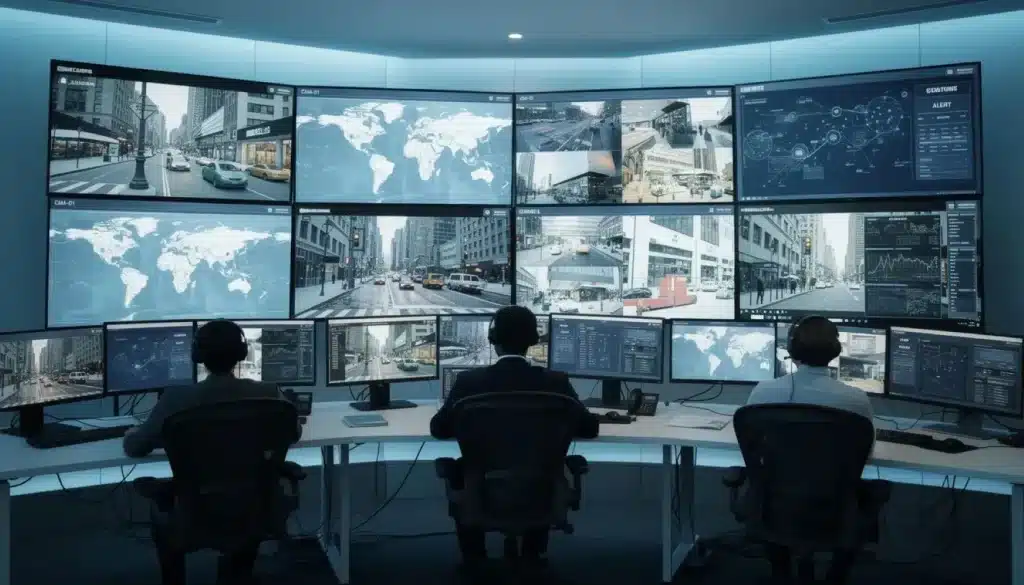
Gunshot triangulation only becomes useful when it feeds into clear, well-defined response workflows. The system can pinpoint a likely location, but that information has to reach the right people and tools quickly enough to matter.
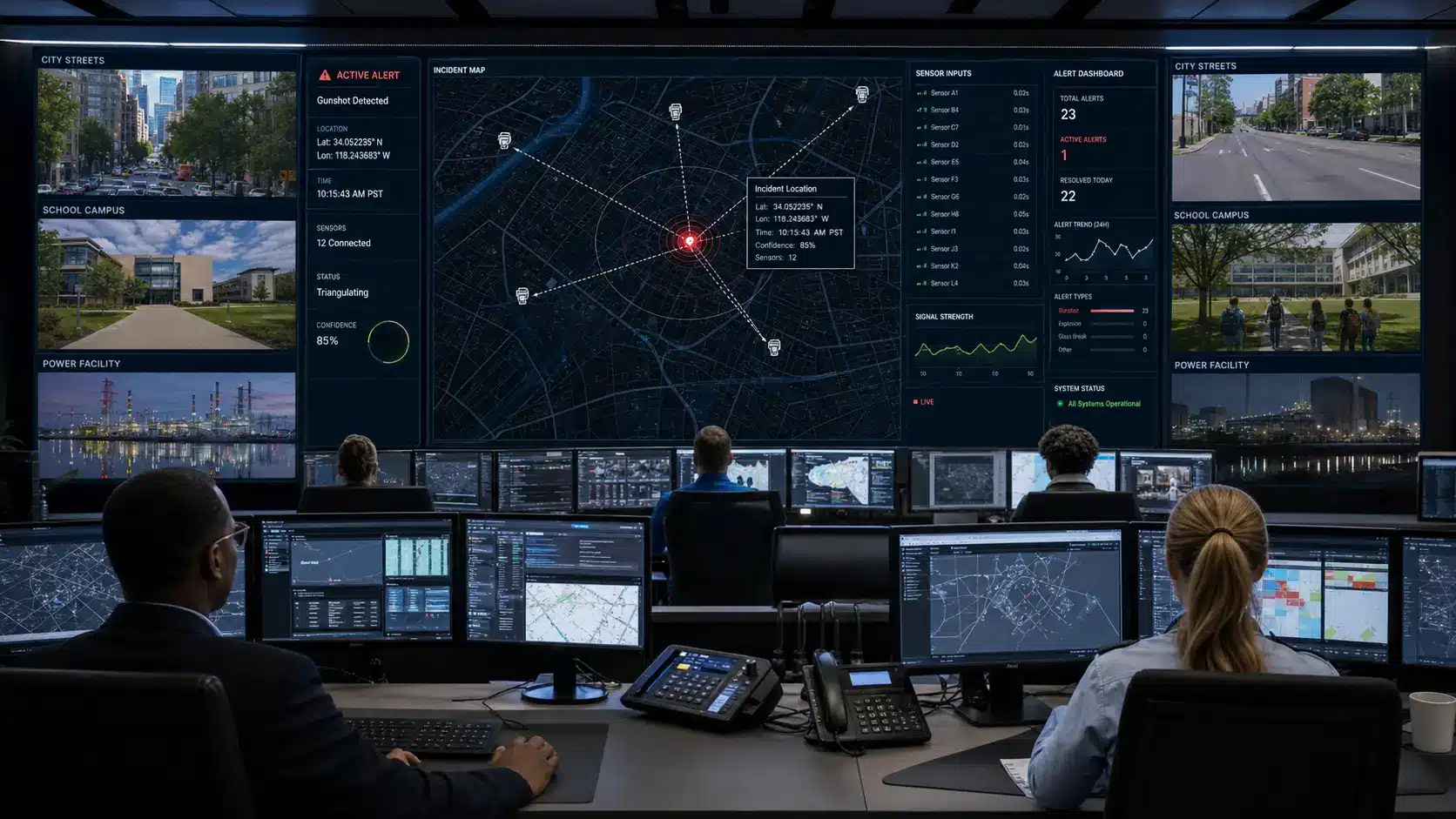
In a 911 center, emergency operations center or security operations center, the triangulated point usually appears on a map along with helpful details like the estimated location, confidence radius, number of shots and timestamp. That gives dispatchers and security teams a clearer starting point for understanding what happened and deciding what to do next.
Automated workflows can take things a step further. A gunfire alert might trigger nearby cameras, help guide door-locking decisions in affected areas or send push notifications to security teams and mobile devices. When triangulation is tied into the broader security ecosystem, organizations can move from detection to coordinated response much more quickly.
For law enforcement and security teams, knowing the location helps with approach planning, officer safety, line of fire awareness and evidence searches. Reviewing the alert, including any sensor data or audio, gives responders a better sense of what they’re walking into before they reach a potentially dangerous area.
Over the long term, organizations can analyze gunfire data to spot patterns by location, time of day or frequency. With the right policies and oversight in place, this information can support resource planning, violence-prevention efforts and ongoing investigations. And when triangulation is integrated with tools like computer-aided dispatch, records management, video systems, access control and mass notification, alerts can move more smoothly into the broader emergency-response workflow.
Accuracy, Limitations and Sources of Error
Gunshot triangulation can be helpful, but real‑world conditions affect how accurate it is. Sensor timing, coverage gaps, weather, background noise, and echoes can all change how precisely a system pinpoints a shot.
Accuracy also depends on the type of gunfire and where it occurs. Suppressors, subsonic rounds, indoor shots, tight spaces and complex terrain can all affect how clearly sensors capture the event. A dense, well-planned network may perform very differently from a sparse deployment or a site with hills, reflective surfaces or irregular building layouts, which is why calibration and verification are essential.
Gunshot triangulation is also reactive by design. It can help locate suspected gunfire after a shot has already been fired, but it cannot identify a visible firearm before the first shot.
False Positives, False Negatives and Community Impact
The accuracy of gunshot triangulation is important for responders, communities, and trust in the system. When technology accurately identifies and locates gunfire, it helps responders arrive more quickly and understand the situation better. However, if alerts are wrong or unclear, these mistakes can affect public safety decisions and shape how communities view the technology.
False positives can lead officers or security teams to respond to incidents where no gunfire has happened. On the other hand, false negatives can result in real gunfire going unnoticed. Both outcomes matter: one can create unnecessary responses and community tension, while the other can create a false sense of coverage. Missed events are especially difficult to measure because they may leave no report, evidence trail or follow-up investigation.
The broader debate around gunshot triangulation often centers on trust, transparency and measurable safety outcomes. Stakeholders often want to understand how alerts are verified, how often they match confirmed gunfire, how the data is used and whether the technology reduces harm or just records incidents after they occur.
Because of these issues, triangulation works best when it’s supported by clear verification steps, transparent policies, community involvement, responsible data practices and regular performance reviews. These measures help ensure the technology improves emergency response instead of harming it.
Privacy, Governance and Ethics
Gunshot triangulation systems can raise real questions about privacy, transparency and oversight because they rely on microphones placed in public or semi-public spaces. Even though these sensors are built to pick up sharp, high-energy sounds like suspected gunfire, organizations still need clear, plain-language policies about what audio is captured, how it’s handled and how it’s used.
Most of these microphones aren’t designed to listen to conversations. Still, anytime you’re using acoustic sensors, people deserve to know exactly what the system records, when it records and who can access any audio tied to an alert. In many setups, the system may save a short audio clip around a suspected gunfire event to help with verification, audits or investigations.
Data governance also plays a big role. Organizations need to spell out how long audio clips, alert logs, location data and response information are kept. Policies should also make it clear who can access the data, when it can be shared and how it may be used in investigations, reporting or legal processes.
Transparency matters. Community members, facility leaders and decision makers often want to understand where sensors are placed, what the system is designed to detect, how alerts are confirmed and what safeguards exist to prevent misuse. Independent reviews, performance reporting and public-facing policies can go a long way toward building trust.
Because these systems are sometimes deployed in sensitive environments, or in communities already concerned about surveillance, responsible implementation should include stakeholder engagement, privacy protections, access controls, audit trails and regular evaluations. The goal is to help responders move quickly when gunfire occurs while making sure the technology is used in a transparent, accountable and tightly scoped way.
Best Practices for Gunshot Triangulation Deployments
Careful design, thoughtful implementation and strong oversight help these systems work reliably and help communities feel confident in how they’re used.
- Take time to survey each site, paying attention to building layouts, everyday noise sources (construction, traffic, nearby venues), and any history of past incidents before choosing where sensors should go.
- Keep the system well-tuned with regular calibration and maintenance: ensure clocks stay in sync across the network, swap out faulty microphones quickly and verify accuracy with controlled test shots at known locations.
- Pair triangulation with visual verification tools (CCTV, license plate readers, body-worn cameras) and establish clear response protocols so teams know exactly how to handle alerts before anyone is dispatched. Include plans for situations involving multiple shooters or extended incidents that require more coordinated action.
- Share high-level performance metrics when possible — detection rates, false positives, response time improvements, and general coverage maps — to support transparency.
- Bring community stakeholders, school boards, elected officials and civil liberties groups into conversations about deployment and data use so decisions aren’t made in a vacuum.
- Set clear data retention limits, access controls and audit trails to help prevent surveillance overreach and reinforce accountability.
Future of Gunshot Triangulation Technology
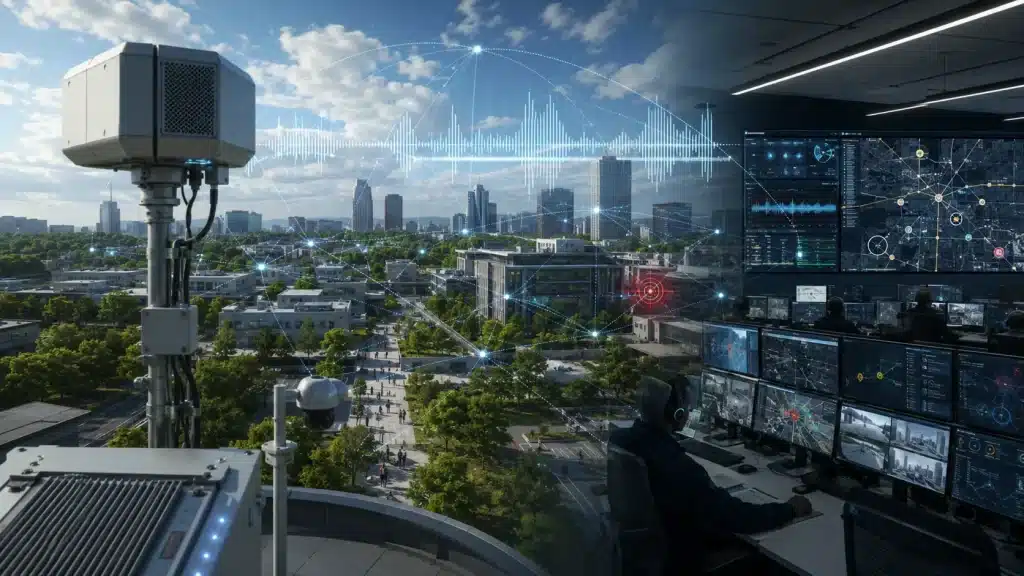
Advances in sensors, artificial intelligence and networking are changing how gunshot triangulation works and how it fits into broader security systems. As the technology evolves, these systems are becoming faster, more accurate and more tightly connected to the tools used for detection, verification and response.
New acoustic sensor designs can improve performance with wider dynamic range, better noise rejection and on-device processing that filters out background noise before anything is sent to a central system. AI and deep-learning models can also help systems make sense of echoes, recognize likely weapon signatures, detect suppressed shots and operate more reliably in challenging environments like dense cities or mixed indoor-outdoor campuses.
Looking ahead, the focus will likely be on faster processing, stronger acoustic filtering, more resilient connectivity and clearer performance standards. Independent validation, standardized benchmarks and transparent reporting will play a growing role in building trust and measuring long-term effectiveness.
AI Gun Detection: A More Proactive Alternative to Gunshot Triangulation
While gunshot triangulation helps organizations figure out where a shot came from after it’s fired, AI gun detection takes a more proactive approach. Instead of waiting for the sound of gunfire, visual AI scans live security camera feeds for anything that looks like a firearm.
It does this by analyzing shapes, patterns and movements in real time. When the system spots something that appears to be a gun, it can send alerts, notify security teams and trigger preset emergency actions. It works with the cameras an organization already has, using computer vision and machine-learning models trained specifically to recognize firearms.
This early-warning capability is especially valuable in places where seconds matter — schools, universities, hospitals, workplaces, houses of worship, retail spaces, outdoor spaces and other busy environments. By turning existing cameras into part of an active threat-detection strategy, AI gun detection helps teams make faster decisions and coordinate their response sooner.
The biggest difference between AI gun detection and gunshot triangulation is timing. Triangulation is reactive — it only starts once a shot has already been fired. AI gun detection can identify a visible weapon before the first shot, giving organizations a critical window to warn people, lock doors, contact first responders and activate emergency procedures earlier.
Visual AI also helps in environments where sound-based detection struggles — places with echoes, loud background noise or lots of impulsive sounds. Because it doesn’t rely on hearing a gunshot, it adds another layer of awareness whenever a firearm is visible on camera.
The strongest setups combine AI detection with human verification, automated workflows, mass notification, access control and clear emergency procedures. Together, these layers help improve accuracy and support a faster, more coordinated response.
For organizations comparing the two technologies, AI gun detection is often the better fit when the goal is to spot a threat earlier, not just locate gunfire after it happens. It shifts the focus from reacting to gunfire to proactively responding to visible weapon threats.
Conclusion
Gunshot triangulation converts the sound of a weapon discharge into location data, helping law enforcement and security teams respond faster after shots are fired. The technology has come a long way from its military origins and can provide valuable situational awareness when it is carefully designed, properly integrated and responsibly governed.
But triangulation is still reactive. It depends on sensor placement, network density, reliable algorithms, clear response workflows and transparent oversight. It can help pinpoint suspected gunfire once an incident is already underway, but it can’t identify a visible firearm before the first shot is fired.
That’s why many organizations are looking beyond acoustic-only systems and considering AI gun detection as a more proactive option. By using existing security cameras to spot visible firearms in real time, AI gun detection can help teams recognize a threat earlier, activate emergency workflows faster and potentially intervene before a situation escalates.
To learn how Omnilert can help your organization detect visible firearms earlier and activate a faster, more coordinated response, explore AI Gun Detection. See how proactive threat detection can help strengthen your safety strategy before a crisis escalates.
Frequently Asked Questions
What is gunshot triangulation?
Gunshot triangulation is a method of estimating where a gunshot came from by using multiple sensors that detect the sound at slightly different times. By comparing those timing differences and sometimes angle data, the system can calculate a likely origin point on a map.
How accurate are gunshot triangulation systems?
Accuracy depends on sensor placement, network density, environmental noise, weather, echoes, building layout and the type of gunfire. A dense, well-planned sensor network can give a more precise location, while sparse coverage or complicated environments naturally create a wider uncertainty zone.
What affects gunshot detection performance?
A lot of everyday conditions can make detection harder — background noise, fireworks, construction sounds, car backfires, wind, temperature changes, reflective surfaces, suppressors, subsonic ammunition and shots fired indoors or in tight spaces. All of these can make it tougher for the system to correctly classify the sound or pinpoint where it came from
How is AI gun detection different from gunshot triangulation?
Gunshot triangulation is reactive. It helps locate suspected gunfire after a shot has already been fired. AI gun detection is more proactive. It uses existing security cameras to spot a visible firearm before shots are fired, giving organizations more time to alert people, notify responders and activate emergency procedures.