In the U.S., gunfire isn’t a rare headline; it’s a daily reality. Between January and December 2024, an estimated 44.4K people died from gun-related injuries (including suicides). That’s roughly 121 deaths a day. With stakes that high, seconds matter. That’s why organizations are investing in detection technologies that can speed response, improve situational awareness and help teams act decisively during a critical incident.
Gunshot detection systems use advanced sensors to instantly identify and locate gunfire, closing the information gap and speeding up response when seconds matter. But there’s an important limitation: gunshot detection is reactive. It confirms danger only after a shot has been fired. That’s why many organizations are now looking beyond gunshot detection alone and adding a proactive layer: AI gun detection that can identify a visible firearm before shots are fired, giving teams more time to act and potentially prevent escalation.
Key Insights
- Gunshot detection systems can improve response by generating rapid alerts and location intelligence, often within seconds to around a minute, depending on the environment and verification workflow.
- Accuracy depends heavily on environment, sensor placement and verification workflows; false positive/limited evidence linkage has been a documented concern in some deployments.
Proactive AI gun detection shifts the timeline forward by detecting firearms before shots are fired, supporting earlier intervention, faster safety workflows and more informed response.
What is Gunshot Detection?

Gunshot detection refers to technology designed to detect the acoustic (and sometimes optical/infrared) signature of gunfire and estimate where it occurred. It’s often used to close the “awareness gap” created when gunfire isn’t called in. Many sources cite low reporting rates and describe gunshot detection as a way to identify incidents that never generate a 911 call.
Most solutions fall into three categories:
- Acoustic sensor networks – microphones that detect impulse sounds
- Infrared / muzzle flash systems– often used indoors
- Hybrid audio-visual approaches – audio confirmation plus video for context
How Does a Gunshot Detection System Work?
While implementations differ, most systems follow the same four-step workflow:
1) Detect the event
Acoustic sensors (microphones) capture impulsive sounds and “flag” events that resemble gunfire. Some indoor systems use a dual-factor approach, confirming an acoustic bang with an infrared flash signature.
2) Classify gunfire vs. non-gunfire
Real-time processing and classification logic help differentiate gunshots from fireworks, car backfires, construction noise and other impulsive sounds. Some vendors include human review as part of the verification chain before dispatching alerts.
3) Locate the incident
In multi-sensor deployments, gunshot triangulation (time-difference-of-arrival) helps estimate the location of the gunfire, so responders can be directed to a specific area more quickly than “somewhere near the sound.”
4) Alert and integrate with other security tools
Many deployments integrate alerts with video workflows to improve situational awareness, so teams can pull nearby camera views and assess what’s happening in context.
Who Are the Key Players in the Gunshot Detection System Space?
The gunshot detection market generally falls into a few segments, and each comes with different strengths and tradeoffs depending on where you’re deploying and who needs to respond.
For outdoor and citywide acoustic networks, SoundThinking (ShotSpotter) is one of the most widely known options, built around community-scale sensor coverage, rapid alerting and workflows that may include human review.
For indoor environments, like schools, commercial buildings and campuses, Guardian by Shooter Detection Systems is often positioned as an indoor-focused approach that pairs acoustic detection with infrared/muzzle flash confirmation to improve confidence in challenging indoor acoustics.
Some organizations also evaluate gunshot detection as part of broader security ecosystem audio analytics, especially when they want tighter coordination with existing security infrastructure. In that category, Bosch / KEENFINITY Intelligent Audio Analytics is commonly framed as an audio analytics capability designed to detect firearm discharge while helping reduce false positives from similar impulsive sounds.
Finally, there are newer entrants and broader public safety platforms that position gunshot/audio detection inside a larger ecosystem of safety tools and integrations. Flock Safety (Raven / Gunshot & Audio Detection) is often discussed in that context, alongside other platforms that emphasize governance and interoperability. EAGL Technology is also increasingly referenced in integrated response conversations, where detection is one piece of a larger “notify, coordinate and respond” stack.
How To Optimize Your Gunshot Detection System for Maximum Accuracy
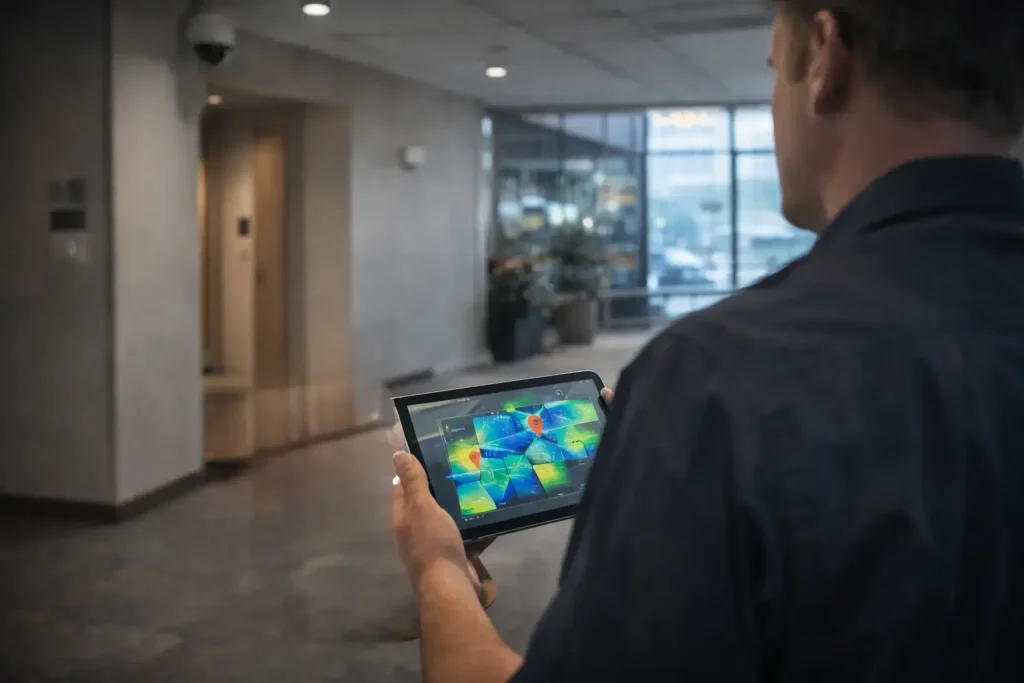
Gunshot detection results can vary significantly based on how the system is deployed and maintained. The biggest gains in accuracy usually come from a few practical, repeatable steps, starting with where you place sensors, how you tune them for your environment and how quickly your team can verify and act once an alert fires.
- Get placement and coverage right. Poor placement is one of the fastest ways to increase false triggers (or miss real events). Focus coverage where risk is highest and where the acoustics support reliable classification:
- Avoid echo-heavy corridors, sharp corners, and “noise canyons” that can distort sound signatures
- Prioritize high-risk zones like entries/exits, parking areas, main hallways and gathering spaces instead of relying on generic grid coverage
- Tune the system to your environment and recalibrate often. A busy environment introduces more impulsive sounds that can look like gunfire to a sensor. That means tuning isn’t a one-time setup; it’s an ongoing process:
- High ambient noise zones (traffic, stadiums, construction) increase the likelihood of false triggers
- Recalibrate regularly as conditions change (construction, seasonal events, new traffic patterns, campus/venue layout changes)
- Integrate video for faster verification. Pairing gunshot alerts with nearby camera views helps teams avoid acting on audio alone and improves situational awareness. Many modern safety platforms position video integration as a key way to confirm incidents faster and respond more confidently, especially when alerts can automatically pull up relevant views.
- Make SOPs and training non-negotiable. Even the best technology can’t compensate for uncertainty in the first minute of a crisis. Your response plan should clearly define what happens in the first 30–60 seconds after an alert:
- Who verifies and how (security, dispatch, command center)
- Who communicates with staff/occupants and when
- What triggers protective actions (lockdown, evacuation, targeted notifications)
- How first responders are guided to the right location and updated in real time
Emerging improvements tend to focus on:
- Better classification models (to reduce false positives)
- Faster verification workflows
- Integration with broader real-time operations (video, mapping and response tools)
But the biggest evolution in many security programs isn’t “better reaction” alone; it’s adding a proactive layer.
Challenges and Limitations with Gunshot Detection

Despite all the benefits, gunshot detection systems have many challenges that can impact their effectiveness and accuracy. New advancements like better acoustic sensors and real-time data analytics are being developed to address these limitations. But these technologies often struggle to differentiate gunfire from other loud noises.
Accuracy and False Positives
Because gunshot detection is triggered after a loud impulse sound occurs, it can’t prevent the initial event. In noisy environments, this can increase the risk of nuisance alerts that still require time to verify. And the fixed location of these systems makes them less effective in dynamic environments, which also contributes to false positives.
Privacy
The use of gunshot detection systems raises big privacy issues, especially around the collection of audio data in public areas. There’s a growing concern that these systems will lead to more surveillance in marginalized communities, which will exacerbate existing tensions. The methodology used by these systems lacks transparency and independent evaluation, which makes the privacy debate more complicated.
Audio-based systems can raise privacy concerns because they rely on microphones in public spaces. A New York City Comptroller report states there is a small possibility of capturing voices near sensors and notes the importance of controls. This unintended consequence raises big ethical questions about the balance between public safety and individual privacy.
Why Proactive Visual AI Gun Detection Is the Better Solution
Gunshot detection can help shorten response after the worst has already happened. But AI Gun Detection Systems are designed to detect firearms before shots are fired, giving teams earlier warning and more time to act.
That proactive window can enable faster lockdown decisions, targeted notifications, and quicker coordination with onsite security or law enforcement – before a situation escalates.
Omnilert’s approach is built around that proactive model: detect the firearm, verify the threat and trigger action immediately.
Gunshot Detection vs. Proactive AI Gun Detection
| Capability | Gunshot Detection System | Proactive AI Gun Detection (Omnilert) |
|---|---|---|
| Detects threat timeline | After shots are fired | Before shots are fired (firearm present) |
| Primary signal | Sound (sometimes flash/IR) | Visual AI firearm detection |
| Best outcome | Faster response to gunfire | Earlier warning + faster prevention actions |
| Typical deployment | Sensor networks (outdoor/indoor) | Leverages existing cameras and workflows |
| Key risk | False positives/negatives from noise & acoustics | Requires clear camera coverage of key areas |
Proactive visual AI gun detection delivers:
- Sub-second detection of potential gun threats
- Automatic security response workflow, not just an alert
- Real-time human verification to help increase confidence and reduce false alarms
- Compatibility with existing cameras, helping organizations scale faster without rebuilding infrastructure.
What proactive visual AI firearm detection gives you that gunshot detection can’t:
- Visual context: Who has the weapon, where they are, which direction they’re moving (more actionable than “sound at location”).
- Earlier decision-making: targeted lockdowns, access control actions, “don’t enter” notifications for staff, and faster command decisions.
- Better evidence for verification: video clips/frames reduce ambiguity vs impulse sounds.
Response Timeline – Where Seconds Are Gained or Lost
Gunshot detection systems and visual AI gun detection operate at different points on the incident timeline. The simplest way to see the value of proactive AI firearm detection is to map when each technology can first create a reliable signal, and how much decision time that gives you before a situation escalates.
Visual AI gun detection: weapon visible → detection/verification → targeted action
Gunshot detection: shot fired → detection/verification → response
Conculsion
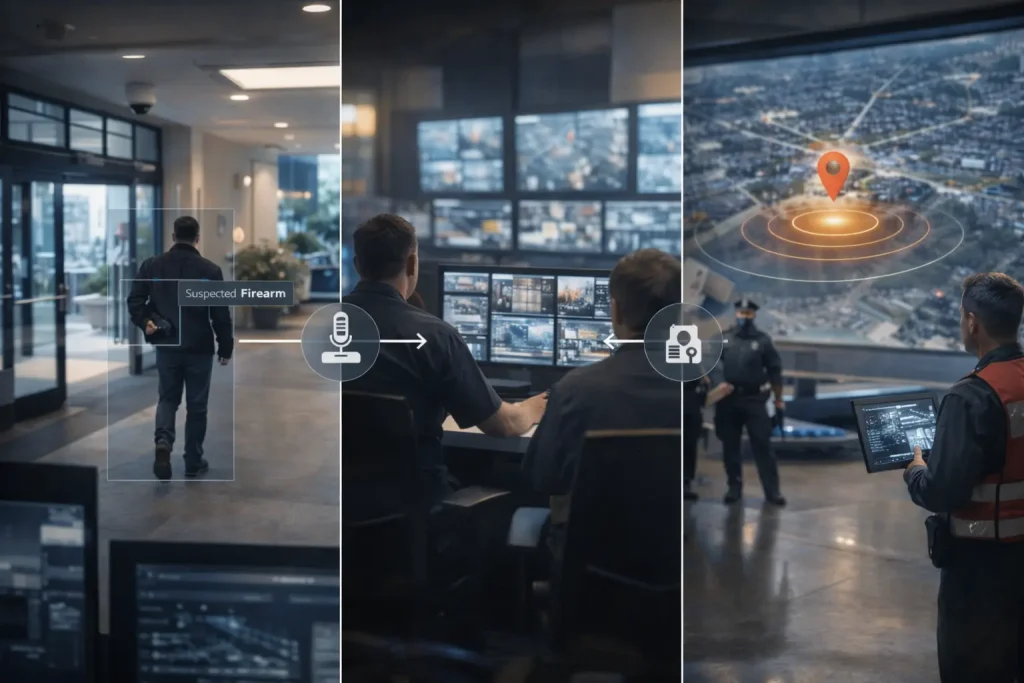
Gunshot detection can speed up awareness once a shot is fired, especially in environments where incidents go unreported or details are unclear in the first moments of an emergency. The best deployments don’t rely on detection alone; they pair accurate coverage with tight operational follow-through: smart sensor placement, ongoing calibration, video integration for faster verification, and well-rehearsed SOPs that spell out exactly what happens in the first 30–60 seconds.
But it’s also important to recognize the built-in limitation of gunshot detection: it’s reactive. It confirms danger only after a shot has been fired. For organizations focused on prevention, not just faster response, proactive visual AI gun detection is the stronger front-line layer because it can detect a visible firearm before shots are fired and initiate a human-verified, workflow-driven response immediately.
Learn more about how Omnilert’s AI Gun Detection helps protect organizations act earlier to protect people when seconds matter to help save lives before shots are fired.
AI Gun Detection Technology
Frequently Asked Questions (FAQs)
Can gunshot detection help law enforcement solve crimes?
Yes, gunshot detection can aid investigations by providing reliable time and location context when witnesses don’t call or can’t provide specifics. Faster awareness can get responders on scene sooner, to help preserve and recover evidence before it’s disturbed or removed. It can also create a clearer incident record for after-action review and trend analysis, which helps agencies and security teams allocate resources more effectively.
How long does it take to alert responders with gunshot detection?
In many deployments, alerts can be generated in about a minute after shots are fired, but the real-world time-to-action depends on your workflow. The fastest outcomes happen when the alert is sent to the right people and paired with quick verification tools (like nearby camera views) and a clear escalation plan. If verification or dispatch steps are unclear or teams aren’t trained, response benefits can be reduced even when detection works as intended.
What’s the biggest risk of gunshot detection?
The biggest risks are accuracy, variability and privacy concerns. False positives can occur when impulsive sounds (fireworks, construction noise, dropped objects) sound like gunfire, and false negatives can occur in difficult acoustic environments. Separately, systems that use microphones can raise concerns about audio collection and surveillance, making transparent governance, policy controls and community communication essential parts of any deployment.
Why add AI gun detection if you already have gunshot detection?
Gunshot detection is reactive; AI gun detection is proactive. AI gun detection can detect a visible firearm before shots are fired, giving you more time to act. That extra time can mean faster protective actions (like targeted notifications or lockdown decisions), quicker coordination with onsite security, and earlier law enforcement engagement, potentially preventing escalation rather than just responding after harm occurs.
Should an organization use both technologies?
Often, yes, because they address different points on the timeline. Proactive AI-based gun detection may warn ahead of an incident if it is going to escalate, and gun detection can verify and locate a shooting if it occurs. Combined, they may improve situational awareness and resilience of response operations in complex environments such as campuses, healthcare facilities, venues, and large workplaces.