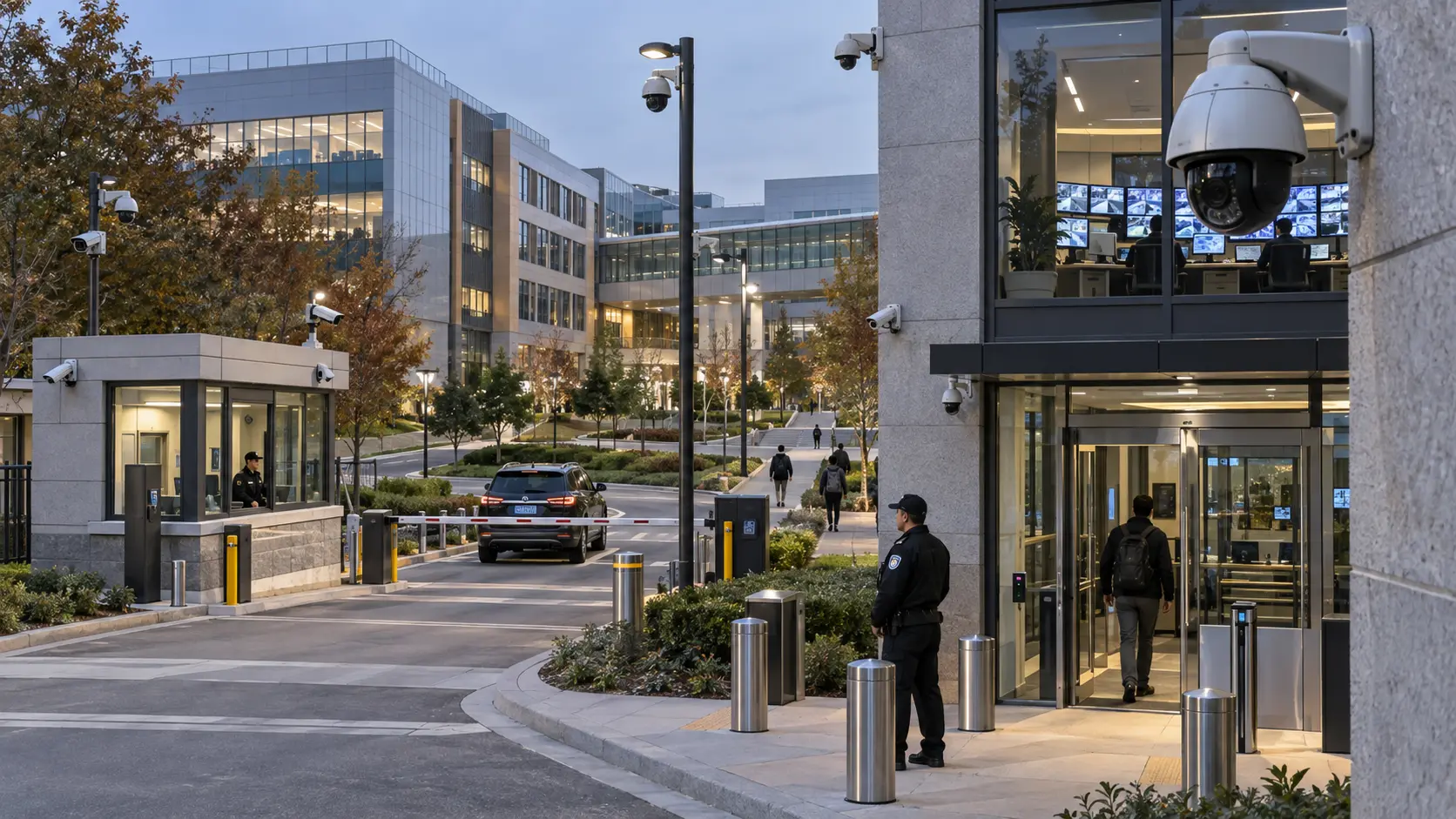
Surveillance cameras are no longer just cameras.
Since it came into common use decades ago, video surveillance has had a very straightforward job: capture what happened, give security personnel visibility, and preserve footage for investigation. As physical security has evolved, organizations have layered increasingly sophisticated technologies onto that same video infrastructure. Visual artificial intelligence can detect weapons, recognize vehicles, monitor restricted areas, and raise the alarm on events that require attention. These detections can trigger alerts and workflows involving security personnel, emergency communications, access control, and other response systems.
This shift is already underway. A 2026 nationally representative Education Week Research Center survey found that 25% of responding school and district leaders reported using AI-enabled security camera monitoring to detect threats or fights. Among teams surveyed by Genetec that use AI in physical-security operations, 63% use it to automatically flag events of interest and 45% use it to assist with emergency-response dispatch.
As organizations add intelligence to their surveillance infrastructure, they also create a new dependency: the technologies built on top of the camera can only perform as well as the visual information the camera provides. Who is assuring that those cameras remain capable of doing the job expected of them?
That’s the gap this piece is about, and it has a name: the Assurance Layer, the part of a security program that verifies whether a camera can still do the job it’s being asked to do, not simply whether it’s connected and recording.
Physical Security Is Becoming a Technology Stack
Modern physical security can increasingly be viewed as a series of interconnected layers.
- The Physical Layer provides protection. Doors, locks, barriers, gates, and other physical safeguards deter, deny, and delay threats from reaching people and critical spaces.
- The Surveillance Layer provides visibility. Cameras, video management systems (VMS), and surveillance infrastructure let organizations see and record what’s happening.
- The Detection Layer adds intelligence. AI and analytics evaluate that video to identify weapons, people, vehicles, intrusions, and other events requiring attention.
- The Response Layer turns information into action. Security personnel, emergency communications, access control, and automation respond to what has been detected.
Organizations are investing heavily in each of these layers, and the pattern holds across sectors. K-12 schools, hospitals, and corporate campuses are all adding analytics and automated response faster than they’re adding staff to verify that any of it is still working as intended.
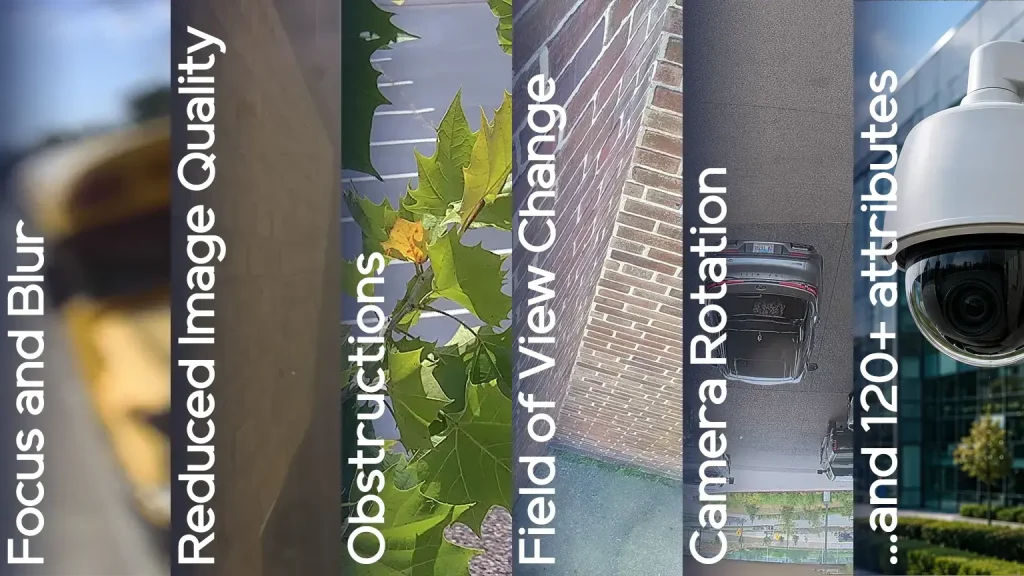
Every capability further up that stack inherits the limitations of the camera feeding it. A camera can be connected to the network, can be communicating with the VMS, be recording, and it can still be incapable of performing the job expected of it. This may be because the image is blurry, the field of view has shifted, lighting has changed, something is obstructing the lens, or the camera simply lacks the visual detail the analytics running on its stream require. Online doesn’t necessarily mean operationally effective.
Availability Is Not the Same as Capability
Picture a camera covering a building entrance. Over a few weeks, its mounting bracket loosens a quarter of an inch. The field of view drifts just enough to clip the doorway it was installed to cover. Nothing about that shows up on a status dashboard. The camera is online, streaming, and recording, exactly as it was the day it was installed. It simply isn’t watching the door anymore.
There’s a difference between camera availability and system capability. It’s easy to miss, because the tools most organizations already use are built to measure availability. Your team can easily confirm whether a camera is online, if it’s recording, or whether the network connection is healthy. Those measurements don’t answer the question that matters most: Can this camera still do the job it was installed to do?
A camera can be online and still produce a blurry image. It can be recording while its field of view is partially obstructed. It can be streaming cleanly while poor lighting hides the part of the scene that matters. It can be technically healthy in every way a VMS reports and still supply too little visual detail for the AI analytics depending on it. From the perspective of traditional monitoring, all of those cameras are functioning normally. From an operational perspective, none of them are doing their job.
Physical Security Already Understands Assurance
The concept isn’t new. Organizations routinely verify critical security technologies rather than assuming that because a system is powered on, it works.
Weapons screening systems are functionally tested regularly to confirm that they actually detect what they’re supposed to detect, not just that they’re plugged in. Access control isn’t validated by confirming the system appears on the network; it’s validated by physically testing doors, readers, and locks to make sure the system actually secures the facility. Fire alarms, emergency communications, and backup power systems all include inspection and testing as a part of normal operations. When a technology performs a security or life-safety function, knowing it’s online isn’t enough. Organizations want to know that it can perform.
Consider a metal detector at a building entrance. No security director would accept a power light as proof the unit can find a weapon. The standard is functional: run something through it and confirm it alerts. That standard exists because the cost of being wrong is a missed weapon, not a support ticket. The same logic should apply to a camera an organization is relying on to do the same job. A status light that says “online” is the equivalent of a power light. It says nothing about whether the camera can actually see what it needs to see.
AI-enabled cameras deserve that same scrutiny. The camera may be online. The VMS may report no errors. The analytic may be running. But is the image reaching that analytic actually good enough to support the task? Until that question is answered, part of the security architecture remains unverified.
The Camera Has Become a Sensor
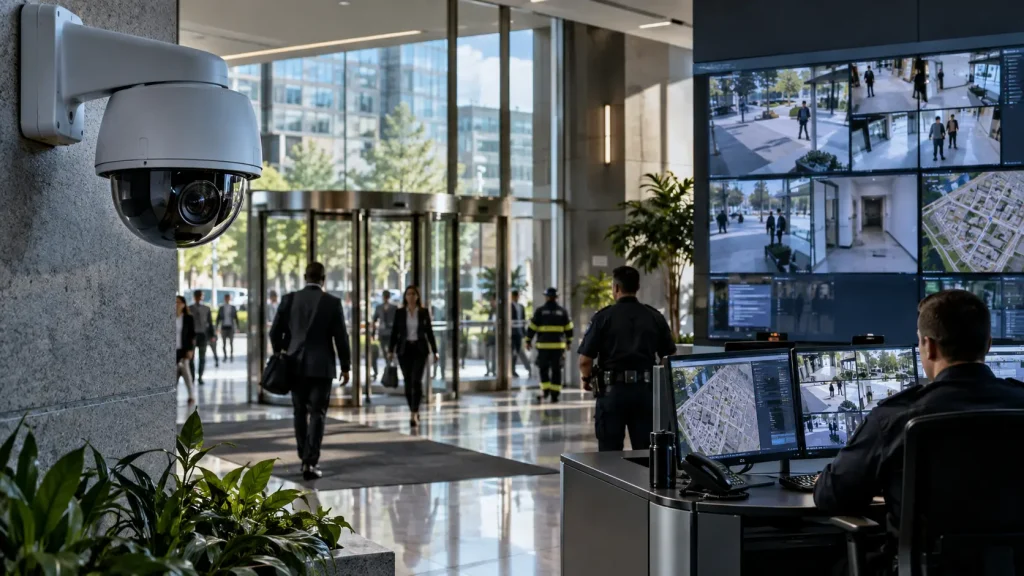
This matters more today because the role of the camera has changed. When surveillance was used mainly for human observation and forensic review, poor image quality was largely a video problem. Today, cameras increasingly serve as sensors feeding other security technologies, and that creates downstream dependencies.
A degraded camera image can affect surveillance, and if AI operates on that image, it also affects detection. If detection triggers automated workflows or emergency response, a failure at the camera level carries consequences well beyond the lens. This results in missed threats, delayed alerts, and gaps in the video record that your organization would later rely on for investigation, liability claims, and compliance.
The smarter the security stack becomes, the more important it is to assure the quality of the foundation underneath it.
Manual Assurance Doesn’t Scale
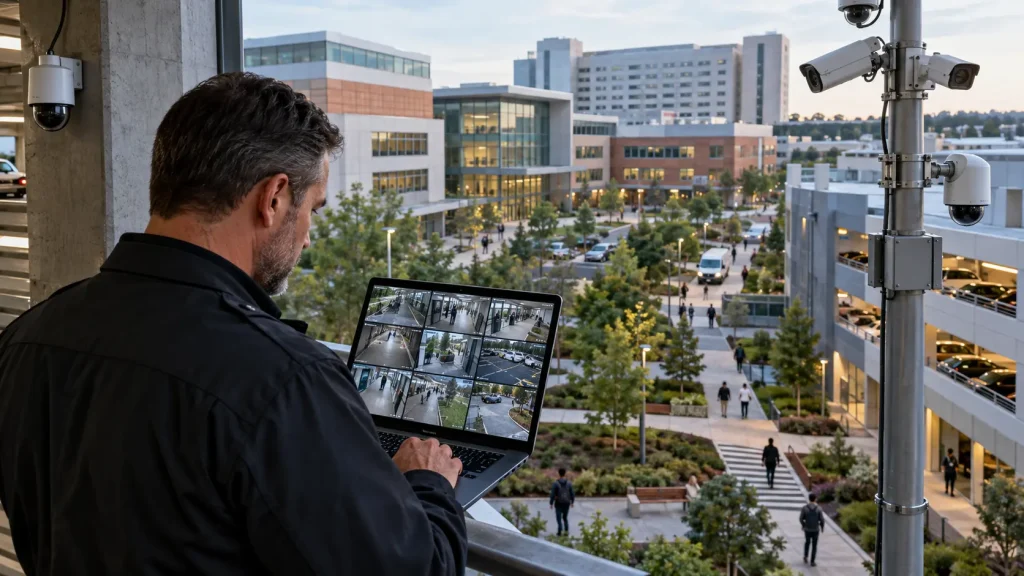
Organizations can perform camera-quality assurance manually. Someone opens each stream, inspects the image, checks focus, evaluates the field of view, identifies obstructions, assesses lighting, and documents what needs attention.
That’s practical with ten cameras. It becomes a different problem at 100, 500, or 1,000. Even at one minute per camera, reviewing 1,000 cameras takes more than 16 hours of uninterrupted inspection. And the moment that review ends, weather, maintenance, vegetation, construction, and normal wear start changing the results again.
There’s a staffing problem layered on top of the scale problem. Education Week’s research includes administrators describing video and access-control monitoring falling to already-stretched administrative staff, with schools struggling to maintain adequate coverage. Those comments are anecdotal rather than representative statistics, but they point to a challenge that extends well beyond education: security technology is scaling faster than the people available to continuously oversee it.
Organizations are automating what their cameras can detect, but assurance of the cameras themselves often remains manual.
That’s the concept. Here’s how Omnilert is putting it into practice.
Omnilert Camera Health: Automating the Assurance Layer
Omnilert Camera Health brings automation to this missing layer of the physical security stack.
Camera Health evaluates connected camera streams to identify conditions that affect their operational usefulness, providing objective, repeatable assessments and actionable reporting that helps organizations identify and prioritize cameras requiring attention.
That creates value across the organization.
- For security teams, Camera Health provides greater confidence that cameras are delivering usable surveillance and forensic video.
- For organizations deploying AI video analytics, it provides another layer of assurance around the visual information those technologies depend on.
- For IT and operations teams, Camera Health drastically reduces the burden of manually inspecting large camera environments.
- For systems integrators and service providers, it offers a simple, scalable way to proactively identify problems, document system performance, recommend remediation, and demonstrate ongoing service value.
- For organizational leadership, it provides timely information to prioritize maintenance, repositioning, lighting improvements, and camera replacement.
Instead of discovering a degraded camera because someone happens to notice, or because footage is needed after an incident, organizations can identify problems before they matter.
Protecting the Investments Already Made
Organizations have already purchased cameras. They’ve invested in VMS platforms. Many are now adding AI analytics and connecting those analytics to monitoring, access control, and emergency communications.
Every additional capability increases the value organizations expect from their video infrastructure. Every additional dependency increases the importance of knowing that infrastructure remains capable of supporting it.
The Assurance Layer isn’t another system competing for those investments. It helps ensure the investments already made can perform as intended, without replacing the surveillance platform, the analytics, or existing system-health monitoring.
The Missing Layer
The evolution of physical security isn’t stopping. Cameras will keep getting smarter. More analytics will run on existing infrastructure. Detection will become more tightly connected to automated response. Security teams will be expected to monitor larger environments with fewer manual processes.
That evolution requires a corresponding shift in how organizations think about camera health. Knowing a camera is connected is important. Knowing it’s recording is important. Knowing its stream is available is important. But when surveillance video becomes the input for systems responsible for detecting critical events, those measures no longer tell the whole story.
Organizations also need assurance that the camera remains capable of performing the job expected of it. That’s the missing layer. That’s the Assurance Layer.
For most organizations, the fastest way to find out where that layer is missing is to ask a simple question: if quality assurance stopped being a manual, occasional task tomorrow, would anyone notice the gap? Camera Health is built to answer that question, and to close it.
Connectivity tells you whether the camera is there.
Assurance tells you whether it can do its job.