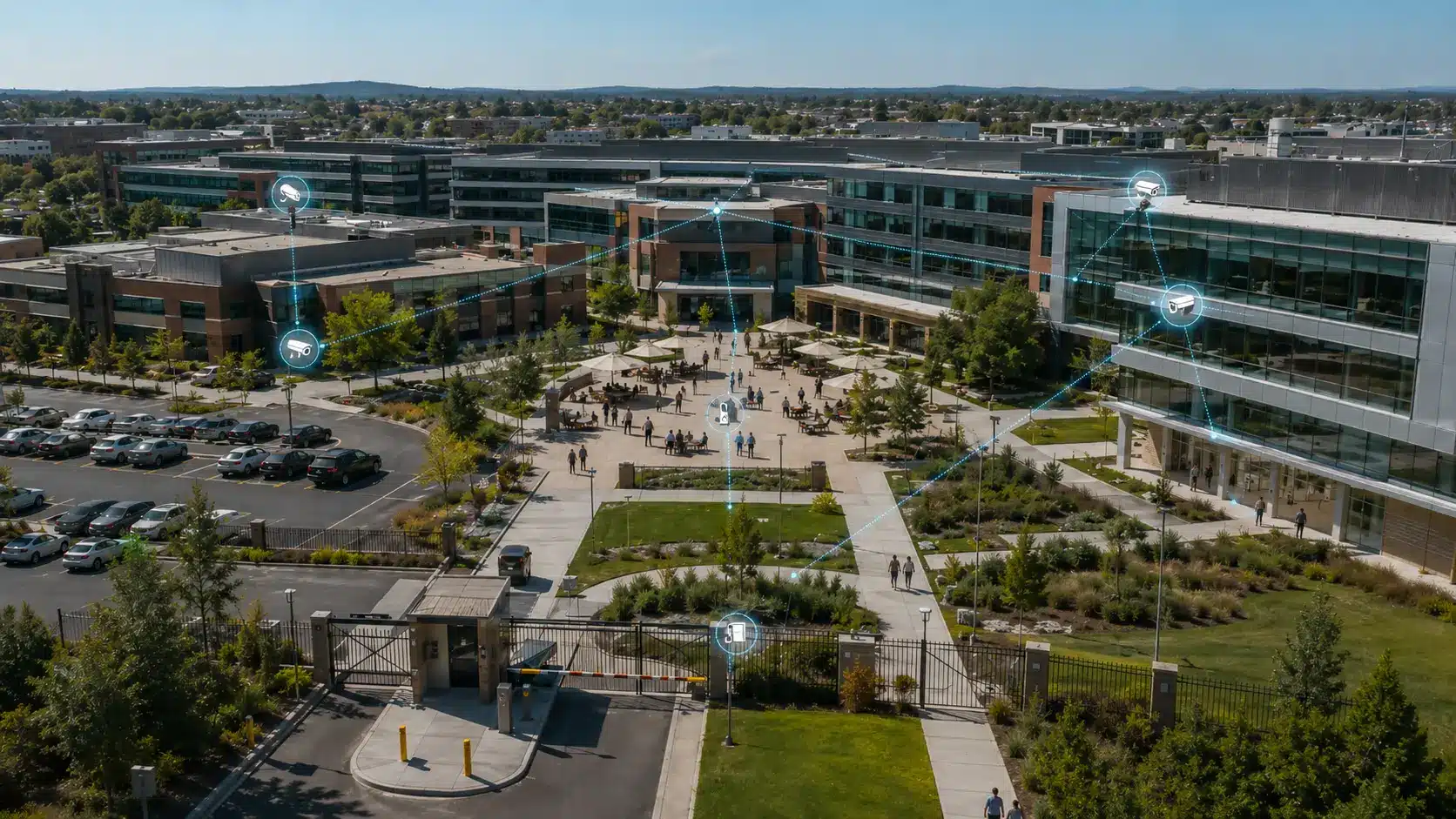
Security teams have more visibility into their facilities than ever before. That’s why real-time threat detection has become an important part of modern security strategies. Cameras, access control systems, sensors, and other tools are constantly streaming information about what’s happening across buildings and campuses. But having more data doesn’t automatically mean teams spot a threat sooner or respond any better.
A critical event can appear on camera and still go unnoticed. An alert may reach the wrong person, arrive without enough context to support a quick decision, or remain isolated from the communication and building systems needed to protect people. This can leave teams finding out about a threat after the fact or responding without the details they need.
Real‑time threat detection can narrow these gaps by getting potential threats in front of security teams faster. But effective response takes more than watching screens all day.
In this article, we’ll examine where the gap between threat detection and emergency response occurs, how connected technologies can help close it, and what organizations should consider when building a coordinated real-time threat detection program.
Key Takeaways
- Incidents can still be missed because human operators on their own can’t watch every camera feed around the clock.
- Delayed awareness shortens the verification and response window.
- Real-time threat detection works best when monitoring, intelligent detection, human verification, communication, and response work together.
- The goal is fewer missed threats and faster, coordinated response.
What Is Real-Time Threat Detection?
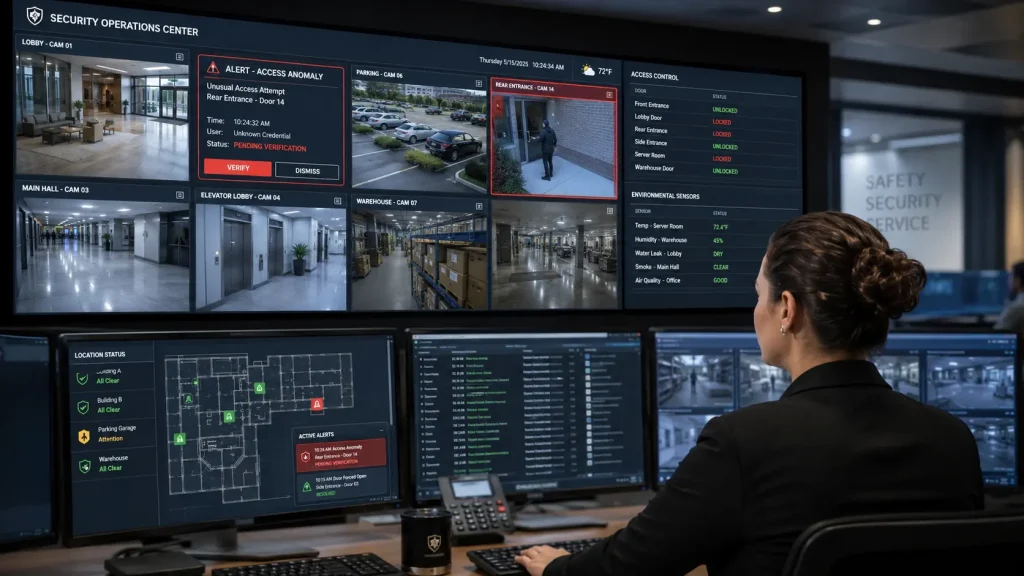
Traditional surveillance systems capture what happened after the fact. Real-time threat detection watches live video, access-control activity and sensors to flag anything that looks unusual. That added awareness helps deter harm and damage.
Here’s how the process works:
- Cameras, access control, and sensors provide a constant stream of live data.
- Analytics and operators spot and verify unusual activity, like weapons or forced entry.
- Verified alerts can trigger lockdowns, emergency notifications, and law enforcement response.
The Real Gap: From Seeing a Threat to Coordinated Response
Identifying a threat is only the beginning. Delays can occur at every stage between the first visible sign of danger and the moment help arrives.
The consequences of those delays can be significant. According to FBI reports, there were 24 active‑shooter incidents across the country in 2024, affecting 106 people – 23 deaths and 83 injuries.
Looking at each stage of the response process can help organizations see where delays are happening:
- Detection – How quickly someone notices something is wrong
- Interpretation – How quickly the operator can tell whether the situation appears to be a real threat
- Verification – Whether there is enough information to understand what’s happening
- Escalation – How quickly the right decision makers have been notified and given the details they need
- Response –How quickly response steps begin, like locking doors, alerting people and notifying first responders
Many organizations can spot potential threats through cameras or access control logs but still struggle to act. Closing that gap requires a seamless connection between detection, verification, escalation and response.
Where Security Can Break Down
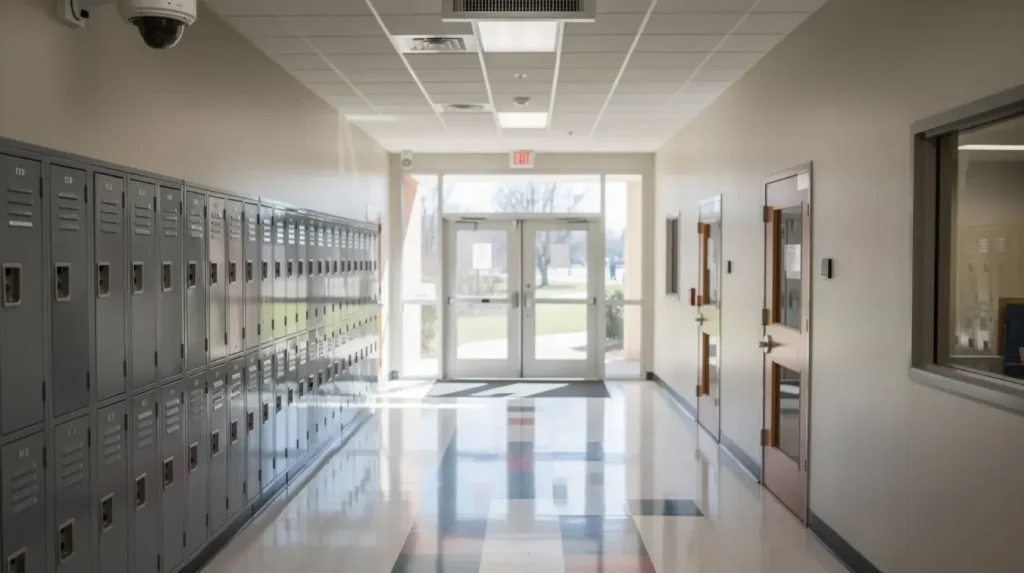
The response gap usually shows up in three areas: missed events, delayed awareness, and fragmented response.
Response Gap #1: Missed Events in “Always-On” Systems
Even with hundreds of cameras and sensors in place, key moments can still be missed. A weapon might appear for only a second. A door could be forced open and held long enough to go unnoticed. Aggressive behavior might unfold just outside a camera’s view. Real-time threat detection helps surface risks that traditional methods overlook, but gaps remain when systems are not well coordinated or when they rely too heavily on people watching screens without a break.
Common causes of missed events include:
- Operator overload – Recent research continues to show that people can miss unexpected visual events when their attention is focused on a demanding monitoring task. Maintaining awareness becomes especially difficult when operators must watch multiple feeds, evaluate frequent alerts, and look for events that occur rarely or without warning.
- Poor camera placement – Low angles, obstructions, insufficient lighting, and narrow fields of view create persistent blind spots.
- Legacy tools – Traditional motion and door sensors can report movement or a change in door status, but they usually can’t provide enough context to determine whether the activity is a serious threat.
Real‑time threat detection can automatically surface events that need attention. It can reduce the pressure on teams to watch every camera feed or system nonstop, and it removes the need to dig through hours of video or multiple logs.
Response Gap #2: Delayed Awareness and Slow Escalation
Even after a potential threat is detected, unclear routing, limited context, and uncertainty about escalation can delay response.
Several common bottlenecks can cause these delays:
- Alerts may pass through several internal layers before security leaders or authorities are contacted.
- Operators may need to review multiple feeds or systems before they have enough context to escalate an alert.
- Unclear policies can slow response decisions.
- Large or multi-building campuses can make it harder to pinpoint where a threat is and who’s at risk.
Real-time threat detection helps security teams see important events sooner and verify them faster. Clear escalation steps then help them move from the first alert to a coordinated response.
Response Gap #3: Fragmented and Uncoordinated Response
A fragmented response happens when security officers, administrators, facilities teams, law enforcement, and building occupants get incomplete, inconsistent, or delayed information. When everyone operates in silos, one group may start responding to a threat while others are still unaware or don’t have the details they need to act.
Consider this scenario: a weapon is detected in a campus parking garage. Security begins responding, but nearby buildings remain unlocked, people in affected areas are not warned, and arriving visitors continue entering because the communication and building systems are not connected. Different groups rely on ad hoc methods, like phone trees, manual PA announcements, and separate radio channels, that were never designed for modern, fast-moving targeted attacks.
Specific failure modes include:
- Duplicate or conflicting messages across departments
- Buildings or zones that are never notified at all
- Responders arriving without a common operating picture of who, what, where, and when
- Malicious activity continuing unchecked in areas outside the initial detection zone
A strong real-time threat detection program must work in conjunction with event management, mass notification, and building systems like locks, signage, and elevator controls. When everything is connected, organizations can follow one coordinated response plan that limits disruption for people and areas that aren’t affected.
The Role of AI Gun Detection in Closing the Response Gap
Active shooter situations can escalate before security teams fully understand what’s happening. Spotting a visible firearm early allows more time to assess the threat and set the response plan in motion.
Omnilert’s AI Gun Detection works with existing security cameras to monitor potential threats, then uses a multi-step process to evaluate them. The system first identifies an individual in the camera view without relying on personal characteristics. It then looks for handguns or long guns near that person and analyzes a sequence of video frames to track the body and gun and determine whether the weapon appears to be brandished. By focusing on the firearm and the surrounding activity, not facial recognition, the system supports a privacy-conscious approach to threat detection.
When a potential gun threat is verified with a high degree of confidence, an alert and supporting video context are sent to the organization’s security operations center or an Omnilert monitoring center for human review. This step helps trained professionals understand what’s happening and decide whether the alert should be escalated.
From Detection to Automated, Coordinated Response
Connecting detection, human review, and action is what turns camera awareness into an operational safety response. Once a threat is confirmed, the next steps should happen quickly, in a coordinated way, and in line with the organization’s established response plan.
This is where Omnilert extends beyond detection and alerting. Its AI gun detection technology is connected to a built-in emergency communications and response-automation platform, allowing a verified threat to initiate predefined actions across the organization’s existing security ecosystem. Rather than requiring teams to move between separate tools and manually launch each part of the response, organizations can establish workflows in advance.
These workflows can notify the right people and activate multiple safety systems at the same time. The right response depends on what the threat is, where it’s happening, which systems are connected to the platform, and the organization’s policies.
Alerts can go out through many channels, including text, email, voice calls, mobile apps, desktop notifications, and public address systems. They can also be targeted to specific people, groups, buildings, or zones so everyone receives instructions that fit their location and role.
Depending on the organization’s configuration, the same automated workflow may activate connected systems such as access control, audible or visual alarms, digital signage, or first-responder notifications.
The goal is not to automate every decision or remove people from the process. Human verification remains a critical step. The purpose of automation is to give security teams a clear, preplanned path from detection and verification to communication and intervention without requiring them to build the response from scratch during an emergency.
Each alert, verification decision, notification, and connected-system action can also be documented. This record helps organizations understand what happened, evaluate how the response plan worked and find areas for improvement for future training, technology configurations and procedures.
Designing a Real-Time Threat Detection Program for Your Facilities
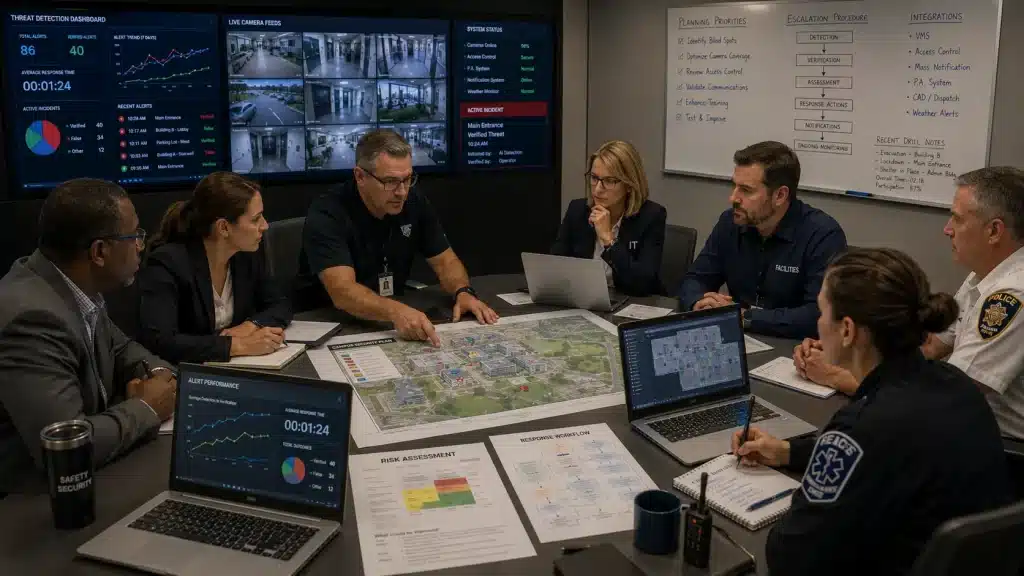
Facility managers and security leaders can use this guide to improve their threat detection and response process. Rather than using separate systems, they can move toward a more unified strategy.
- Site-specific risk assessment – Walk through each building, entrance, high‑traffic area, and critical space. Make a list of which cameras, sensors and security systems are monitoring those places.
- Gap analysis – Look for blind spots and areas with unreliable communications. Note which places rely on manual alarms and where response times are typically slow.
- Prioritized upgrade plan – Start by making the most impactful changes. Address those blind spots, add detection tools in risky areas, and connect your access control and notification systems. Use the infrastructure you already have to keep costs down and simplify installation.
- Governance and training – Create clear policies that explain all of your processes. Run regular drills to practice these automated response procedures so everyone will know what to do in an emergency. Make sure the policies align with your organization’s privacy, security, and regulatory requirements.
- Ongoing evaluation – Evaluate camera coverage, alert quality, verification speed, and response time. Update training as your environment changes.
Beyond Firearms: Expanding Real-Time Detection to A Broader Range of Physical Threats
Firearms are one of the most serious threats an organization can face, but they are not the only situations that need a fast, coordinated response. Security teams must be able to recognize other activity that could threaten safety, such as forced entry, unauthorized access, escalating confrontations, vehicle break-ins, and crowd surges,
National workplace violence data makes it clear that organizations need to be ready for more than just one type of threat. In 2024, the U.S. Bureau of Labor Statistics recorded 733 workplace deaths caused by violent acts, including 470 homicides and 379 shootings.
The risk is particularly pronounced in healthcare. According to the CDC’s National Institute for Occupational Safety and Health, healthcare and social assistance workers face the greatest risk of nonfatal workplace violence serious enough to require time away from work.
No single security tool can identify every type of threat. Video analytics may flag unusual movement, loitering, or crowding. Access control systems can catch forced doors or repeated attempts to enter restricted areas. Panic buttons, intercoms, and environmental sensors can add important context.
The goal is not to rely on one technology to identify every possible risk. It is to bring relevant ones into a coordinated process and apply the appropriate procedures to each type of event.
Measuring Success and Continuously Improving Real-Time Detection
Because real-time threat detection requires regular testing, review, and fine-tuning, organizations should keep track of important metrics like:
- How long it takes to spot the first visible sign of a threat
- The time between initial detection and human verification
- The speed of response after a verified alert
- Alert accuracy and false‑positive trends
- The number of alerts resolved using standard procedures
Running drills and realistic scenarios can test detection, verification, communication, and response under pressure. These exercises can uncover unclear roles, missed notifications, weak camera coverage, or slow handoffs between systems.
After an incident or practice run, security teams, facility leaders, administrators, and first responders should review what went well, what caused delays, and where things can improve. That might mean adjusting camera placement, refining alert thresholds, clarifying escalation steps, updating notification lists, or revising response plans.
Turning Real-Time Awareness into Readiness
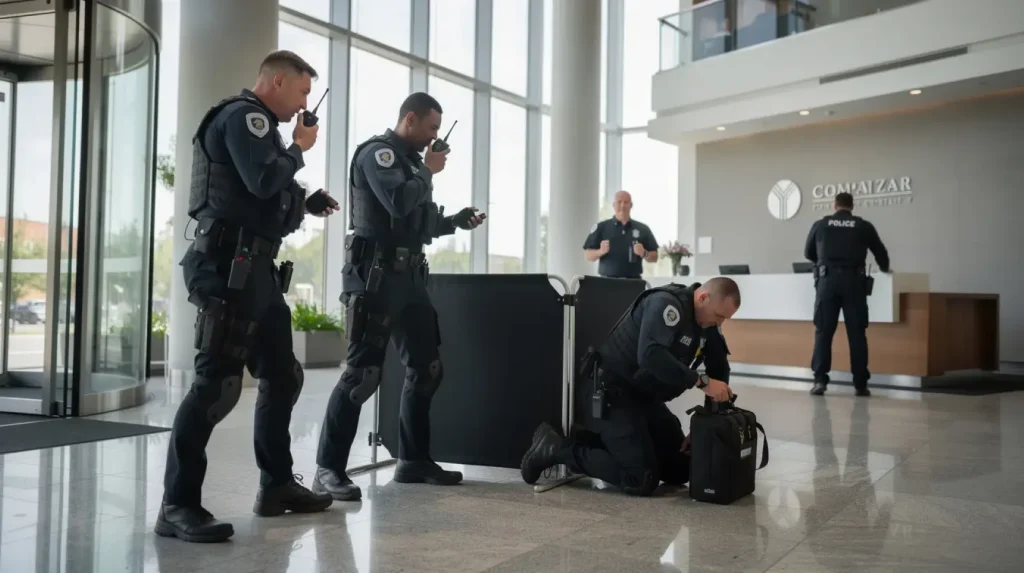
The strongest real-time threat detection programs begin by defining what must happen after a credible threat is identified. Who verifies the alert? Who needs to know? Which protective actions should begin, and which decisions must remain in human hands?
Organizations that answer these questions in advance and support the process with connected technology, clear responsibilities, and practiced procedures are better prepared to act without hesitation or confusion. When detection is treated as the beginning of the process rather than the end, awareness can lead to faster, more coordinated response measures.
Learn how Omnilert can help your organization connect real-time threat detection with verified alerts, emergency communication, and coordinated response workflows.
Frequently Asked Questions (FAQs)
Is real-time physical threat detection the same as traditional video surveillance?
Traditional surveillance records events for later review. Real-time threat detection monitors live activity, flags potential threats, and helps security teams respond sooner.
How does AI gun detection differ from generic motion or object detection analytics?
Motion detection identifies movement, while basic object analytics recognize common shapes or objects. AI gun detection is trained to identify visible firearms, evaluate the surrounding context, and send potential threats for human verification before a response begins.
Will AI-based detection tools replace human security officers?
AI is designed to augment, not replace, human security teams. It takes on the nonstop monitoring that no one could realistically keep up with across dozens or even hundreds of cameras. People are still crucial for the things that require judgment, policy decisions, real‑world response, and communication with building occupants or law enforcement. The AI’s job is to make sure officers get alerts faster and with clearer, more actionable details—boosting their effectiveness, not replacing them.
How can we address privacy concerns when using AI video analytics?
Choose solutions that focus on object detection and behaviors and not ones that identify people. Set clear policies, access controls, and data-retention limits. Communicate with employees, students, and visitors about how and why these analytics are used. This can help protect privacy while still allowing for real‑time threat detection.
What is a realistic timeline for implementing a real-time detection program?
Timelines are dependent upon the number of cameras and where they’re located, what systems are already in place, integration needs, approvals, and training. Most organizations start a pilot first, then scale to more sites.