Security teams today are being asked to do more than ever: spot threats sooner, cut down on false alarms, and move quickly when every second counts. With AI-powered video analytics and automated response tools becoming more sophisticated, many organizations are shifting away from a purely reactive mindset and toward a more proactive, intelligence-driven approach known as predictive security.
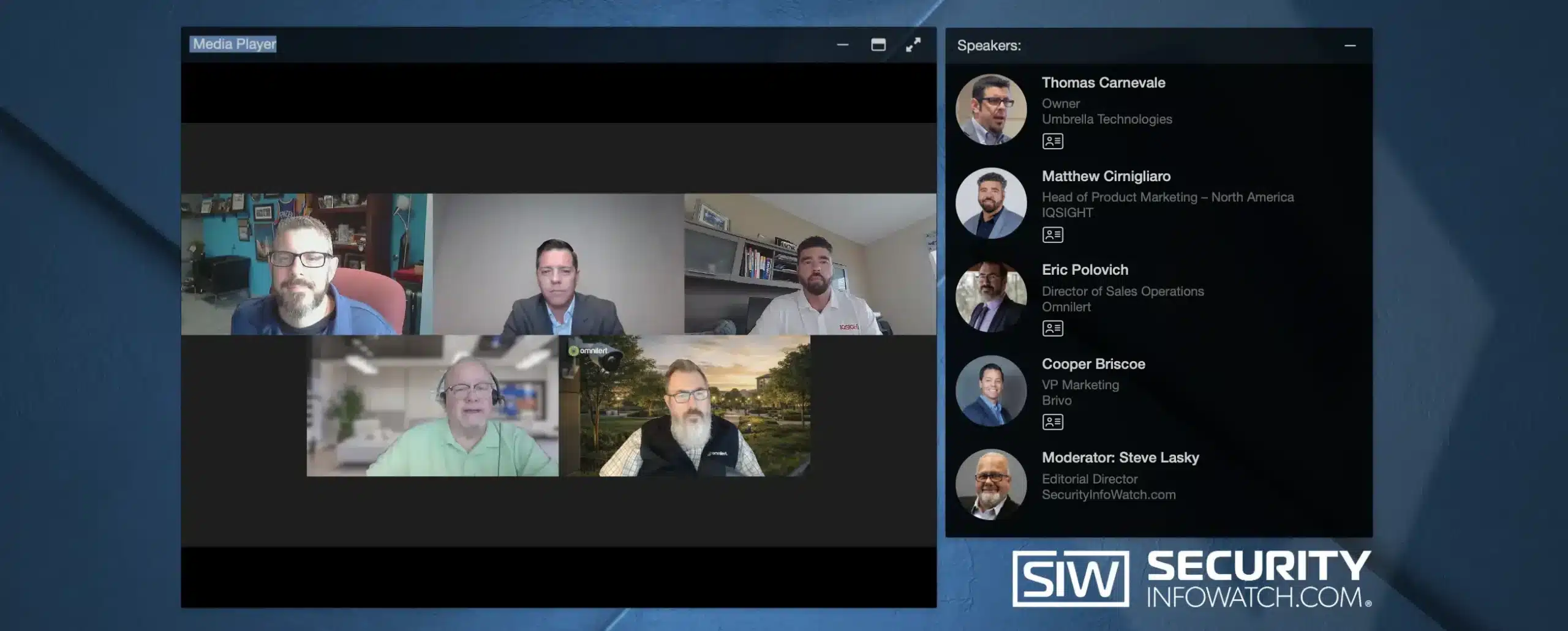
That shift was front and center in a recent SecurityInfoWatch webinar sponsored by Omnilert, Brivo, IQsight, and Ganz. Industry experts dug into what “predictive security” really looks like right now, how AI-driven analytics are reshaping day-to-day operations, and why technology alone can’t deliver better outcomes without the right people, processes, and planning behind it.
The discussion was moderated by Steve Lasky, Director of Content for Endeavor Business Media Security Group, and featured:
- Thomas Carnevale, owner of Umbrella Security Systems
- Matt Cirnigliaro, Head of Product Marketing for North America at IQsight
- Eric Polovich, Director of Product & Partner Enablement at Omnilert
- Cooper Briscoe, VP of Marketing at Brivo
Together, the panel explored how predictive analytics, AI, automation, and human oversight can help organizations move from detection to faster, more coordinated response.
What Predictive Security Really Means Today
The term “predictive security” can sound futuristic, but the panel made clear that it is not about predicting the future with certainty. Instead, it is about recognizing indicators of potential risk earlier in the incident timeline.
AI-powered systems are getting better at noticing what’s normal and what’s not, spotting unusual behavior, recognizing important objects, and flagging activity that might need a closer look. Because everything is happening in real time, security teams aren’t left reacting after the damage is done or scrubbing through endless video to piece things together. Instead, they get information as it unfolds, which helps them stay a step ahead rather than constantly trying to catch up.
A key theme throughout the discussion was that the value of predictive security is not simply detecting an event. The real value lies in enabling better decisions.
Rather than asking, “Can AI detect this?” organizations should ask, “What decision should this alert trigger, and who owns that decision?” This distinction is critical. Predictive analytics should support human decision-making, not replace it.
From Reactive Security to Predictive Security
For decades, video surveillance has often served as a forensic tool. Cameras helped organizations understand what happened after the fact. Today, AI-powered analytics are changing that role by helping security teams identify potential warning signs sooner.
The panel discussed examples such as loitering detection, unusual vehicle activity, perimeter monitoring, object detection, and gun detection. These capabilities can help organizations move beyond simply recording incidents and begin recognizing conditions that may require attention before a situation escalates.
One important takeaway was that earlier awareness creates additional opportunities to act.
When a threat shows up right at a building entrance, there’s almost no time to react. But if it’s spotted sooner, like out in a parking lot, along a perimeter, or earlier in the timeline, those extra moments can make a real difference. That early warning gives organizations a chance to start response procedures before the situation reaches their front door.
Turning Detection into Action
A major takeaway from the webinar was that detection is only the first step.
An alert that is not connected to a plan, process, or response workflow has limited operational value. Detection alone does not improve security outcomes. Response does.
Eric Polovich of Omnilert explained that AI can surface critical information quickly, but that information must be packaged in a way that supports immediate action. For example, a modern detection system may provide images, video, location data, metadata, and context to the people responsible for making decisions.
That intelligence becomes most valuable when it is connected to automated workflows, such as:
- Sending emergency notifications
- Alerting security teams
- Notifying first responders
- Triggering alarms
- Locking doors or integrating with access control
- Activating predefined response procedures
In an active threat situation, every second counts. A gun detection alert shouldn’t exist on its own. It needs to plug into a full response plan, one that includes a quick human check, clear emergency notifications, lockdown steps, and direct communication with first responders.
When detection, communication, and response tools are all working in sync, organizations can move from “we know something is happening” to “we’re taking action” much faster. That’s where AI really shines: it gives teams the boost they need to respond with speed and confidence when every moment matters.
Reducing Alert Fatigue with Smarter Automation
Security teams already face overwhelming amounts of video, access control data, sensor inputs, and alerts. One risk with any new technology is that it may simply replace one kind of alert fatigue with another.
The panel talked about how AI and automation, when used thoughtfully, can lighten the load for security teams. Instead of notifying every time a stray cat strolls past a camera or a gust of wind sets something in motion, these systems learn to ignore the everyday background noise and only focus on what actually needs attention.
They can also help keep situations from escalating. If someone is hanging around a restricted area after hours, the system might start with a gentle automated audio warning. If the person sticks around, it can gradually raise the stakes, issuing a firmer warning, notifying a monitoring center, sounding a siren, or looping in security staff. It’s a way to respond quickly without overreacting.
This kind of workflow helps ensure that human operators are brought in when the situation requires judgment, rather than forcing them to review every minor alert. By the time an alert reaches a person, the system can provide added context: what happened, how long it has been happening, what actions have already been taken, and why the event matters.
The Importance of Human Oversight
Even as AI becomes better at detecting, analyzing, and prioritizing potential risks, human oversight remains essential. The panel emphasized that AI should help security teams make faster, more informed decisions, not make final decisions on its own.
Security environments are messy, and unusual behavior doesn’t always mean something is wrong. A crowd might be the start of a conflict, or it might just be people gathering for something harmless. A vehicle parked in an unusual spot may seem suspicious in some situations and normal in others.
Context is important, which is why organizations need clear guidelines, simple warning signs, and well‑documented response procedures. AI can help flag potential risks, but people are needed to interpret what’s really happening, apply judgement and make the final call.
The panel also stressed the importance of trust. For AI to be effective, teams must believe in it. It’s earned through accuracy, consistently tracking false positives, transparency about how the system works, and ongoing improvement. Organizations should understand how alerts are generated and verified, and who is responsible for each step of the response.
Building a Unified Operational Picture
Modern security environments increasingly rely on a mix of technologies: video analytics, access control, gun detection, sensors, alarms, emergency notification systems, and more. The long-term goal for many organizations is to bring these systems into a more unified operational picture.
However, the panel noted that “single pane of glass” solutions only work if they remain usable. A platform that collects every possible data point but becomes too complicated for teams to use may not improve outcomes.
The key is to aggregate meaningful data and present it in a way that supports the specific user’s role. A school resource officer, a security operations center operator, a facilities leader, and a front-desk employee may all need different information from the same security ecosystem.
Unified security is not just about connecting systems. It is about delivering the right information to the right people at the right time.
Predictive Security Requires People, Process, and Technology
The future of security is about giving teams clearer, faster information so they can focus on real threats instead of getting overwhelmed by noise. As the panel pointed out, the real impact won’t come from technology alone. Strong planning, good training, thoughtful integration, clear roles, and genuine trust will determine how well these tools actually work.
Omnilert helps support that shift by connecting detection to action through AI-powered gun detection, emergency communication, and automated response tools.
For teams looking to strengthen their response strategy, scheduling a demo is a practical next step to explore how these capabilities can work together to create a faster, more coordinated security response.