For the 2026–27 school year, the Pennsylvania Commission on Crime and Delinquency’s safety and security committee is making approximately $138.779 million available through its School Safety & Mental Health Grant program. This is the largest single-year allocation to date for PCCD’s school safety grants, funded with a $100 million FY 2026–27 appropriation and an addition of unexpended money from prior years
The grants can be used for public school safety and mental health initiatives, a scale that gives every eligible school entity a real opportunity to address school violence, strengthen security, and expand mental health support. Applications for PCCD funding must be submitted through the Egrants system by October 16, 2026.
This article covers who is eligible, how much funding each school can receive, what the grants can pay for, how baseline criteria shape your spending plan, and how to think strategically about physical security investments, including where AI gun detection might fit.
Things to Know
- The grant program is noncompetitive and formula-based; public school districts receive a base allocation of $100,000, and charter schools, intermediate units, and career or technical centers receive $70,000 with additional formula funding based on enrollment for districts.
- The deadline to apply for funding is October 16, 2026, and applicants should submit their applications in PCCD’s Egrants system.
- Schools should first use grant funding to address unmet Level 1 Baseline Criteria. Once all applicable Level 1 criteria are met, funding may be used for other eligible activities under Pennsylvania’s Public School Code.
- The PCCD program links safety improvements with mental health resources, so effective threat prevention requires both detection and intervention programs.
- Proposed expenses should address identified safety or behavioral health needs and align with PCCD’s Baseline Criteria and eligible grant activities.
- AI gun detection and other school security technologies may fit within eligible physical security categories, but schools should confirm eligibility against PCCD’s current funding guidance
What Are the 2026–27 PCCD School Safety & Mental Health Grants?

This grant program is designed to help Pennsylvania public schools improve school safety and expand access to mental health and behavioral health resources. It is administered by PCCD’s School Safety and Security Committee, and all awards are distributed through a noncompetitive, formula-based grant program. This means eligible entities do not have to compete against each other for a limited pool and every qualifying school entity receives a predetermined allocation.
The total funding of $138.779 million combines $100 million in new FY 2026–27 appropriations from the School Safety and Security Fund with unexpended, uncommitted, and unencumbered balances from earlier years. The grants can cover behavioral health and school mental health initiatives, physical school safety and security enhancements, and integrated approaches that combine both. Only public school entities are eligible for this specific solicitation; a separate targeted program exists for nonpublic schools.
Applications should document specific safety and mental health needs, and all submissions go through PCCD’s Egrants platform. Pennsylvania schools can also find grants on education.pa.gov and grants.gov for additional school safety funding opportunities.
Who Is Eligible and How Much Funding Can Each School Receive?
Eligibility for this solicitation is limited to Pennsylvania public school entities. Eligible public school entities include districts, charter schools, and intermediate units, along with regional charter schools, cyber charter schools, and area career and technical centers. Approximately 775 public school entities statewide are expected to be eligible based on PCCD’s projections, and each entity has a predetermined allocation listed in PCCD’s funding materials.
School Districts
Every school district receives a base allocation of $100,000 plus additional funding tied to its 2024–25 adjusted average daily membership (AADM). For example, a mid-sized district with several thousand students might receive $150,000-190,000, while a smaller district could receive closer to the base. A legislative district in northeastern Pennsylvania received roughly $1.03 million this August, split across six school districts and a career center, with individual district allocations ranging from about $140,000 to $190,000.
CTCs, Intermediate Units, and Charter Schools
Each charter school, regional charter school, cyber charter school, intermediate unit, and area career and technical center is eligible for a base allocation of $70,000. There is no additional AADM-based formula add-on for these entities. Schools should confirm the exact figure in PCCD’s official allocation list rather than estimating.
Nonpublic Schools: A Separate Program
The PCCD has launched a separate grant program for schools that are nonpublic, including independent and faith-based institutions. In past years, Pennsylvania offered grants up to $75,000 for nonpublic schools under this separate Targeted School Safety Grants program, with its own eligibility rules and timeline. Applications for nonpublic school grants are typically due in the springtime. Pennsylvania’s PCCD program has recently allocated $20.7 million for safety and mental health specifically for these entities, and nonpublic schools should monitor pccd.pa.gov for current and future announcements.
Allowable Uses: School Safety, Security, and Behavioral Health Investments

Allowed uses are tied to PCCD’s Physical Security and Behavioral Health/School Climate Baseline Criteria, and a full list of eligible and ineligible expenses can be found on pages 6–9 of the Pennsylvania Commission on Crime and Delinquency’s FY 2026-27 grants guide.
Schools should use these criteria as a guide for prioritizing grant expenditures. A single grant can fund both physical security and behavioral health projects if justified by data.
Behavioral Health and Student Mental Health
One of the main objectives of the grant program is to address safety and security in schools through the support of behavioral and mental health. Student mental health supports can include counseling, trauma-informed practices, and suicide prevention. Schools can use grant funding to hire or contract with school counselors, school psychologists, and social workers; expand school-based mental health services; implement positive behavioral interventions and supports; and launch school climate initiatives that address school violence and bullying.
PCCD encourages programs that promote student connectedness to reduce absenteeism, and data from community organizations or local student surveys can help justify these investments. Schools should account for risk factors such as lack of access to services, trauma exposure, and gaps in family and student engagement.
Before finalizing a grant application, verify each line item against the current PCCD allowable and unallowable cost guidance, confirm alignment with baseline criteria, ensure no duplication of funding and document how each expenditure connects to a safety or mental health need.
Physical School Safety and Security
The PCCD’s grants can be used to fund a range of security and security technologies and emergency communication systems. Concrete eligible uses for physical security improvements include comprehensive school safety assessments, visitor management systems, secure entry and access control, security cameras and video management systems, weapons detection technology, surveillance cameras, emergency communication tools such as PA and mass notification, lighting, fencing, and training for school security personnel.
Understanding PCCD Baseline Criteria and Planning Your Strategy
PCCD’s School Safety and Security Committee has separate baseline criteria documents, one for physical security and one for behavioral health and school climate, which were reviewed and updated in June 2026 to guide how school safety and mental health grants are used. Level 1 Baseline Criteria are foundational conditions every school entity should meet. The 2026–27 grant framework strongly encourages, and in some cases requires, schools to use funding first to meet these Level 1 needs before moving to more advanced activities.
Once Level 1 criteria are met in a given area, schools have more flexibility to use remaining funds for additional enhancements allowed under the Public School Code and PCCD guidelines. Level 1 activities might include things like conducting a school safety assessment, establishing or refining a threat assessment team, having basic emergency communication during the school day, running emergency drills, and minimum counseling and behavioral health support.
School leaders should form or engage their school entity’s security committee to review baseline criteria, recent assessment results, and current school safety and mental health data. This ensures grant proposals are a coordinated district-wide strategy, not ad hoc purchases.
The bottom line: review the updated baseline criteria, compare to current capabilities, identify gaps and then map each budget line item to a documented school safety or behavioral health need. Keep documentation thorough… PCCD often requires it and audits are part of the program.
Prioritizing Physical Security Investments
Rather than treating security purchases as isolated line items, school districts and other public schools should think in terms of a layered school safety and security approach. The central question is how detection, communication, and response work together to reduce danger when a threat emerges.
Questions administrators and technology teams should ask:
- Where are our biggest detection blind spots?
- How quickly can school security personnel or school resource officers verify a reported weapon or threat?
- How are staff, students, and school resource officers notified in real time?
- How is critical information shared with law enforcement agencies and first responders?
- Do our current systems support both everyday emergencies and high-impact threats?
- Can existing security cameras provide greater value through AI-driven analysis?
Potential Safety Investment: AI Gun Detection
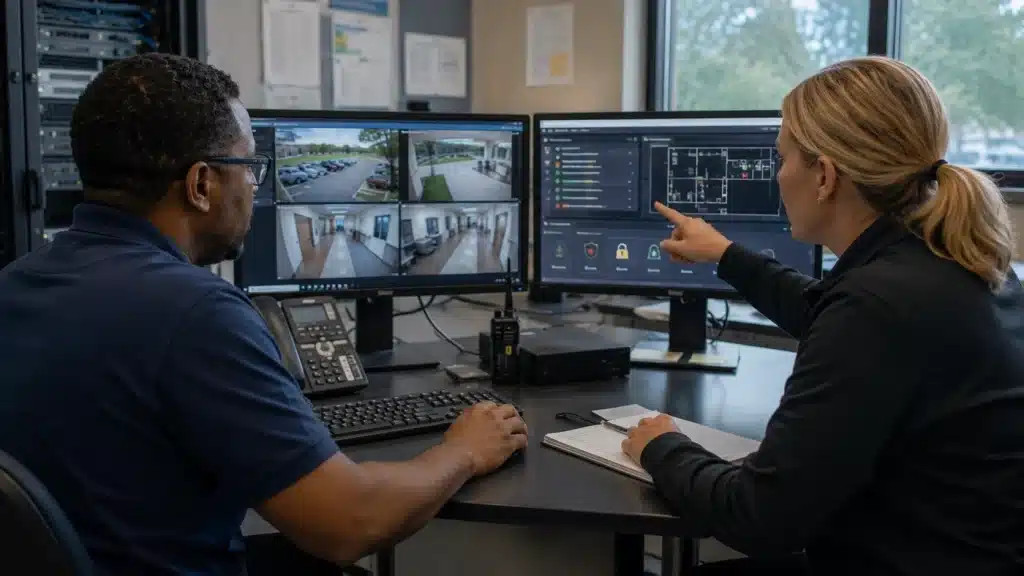
As schools evaluate their biggest threats and needs, districts that are more impacted by gun violence may find AI gun detection systems to be a potential solution for earlier firearm threat identification. The technology can be deployed on top of schools’ existing security camera systems to identify visible firearms in real time, route alerts to designated personnel for verification, and then trigger established emergency procedures. It should be part of a broader safety strategy, not a standalone solution; best practices involve integration with access control, emergency notification platforms, public address systems, digital signage, and first responder communication tools to support a connected emergency response workflow.
While many types of school security technology, including AI gun detection, may fit within allowable physical security categories, each district must confirm eligibility and alignment with PCCD’s baseline criteria and statutory requirements. Proposed legislation such as Pennsylvania House Bill 2206 would explicitly add firearm detection technology to the Public School Code, which could further clarify grant eligibility.
Application Essentials, Timeline, and Practical Tips for School Districts
Applications for the 2026–27 PCCD School Safety & Mental Health Grants must be submitted in PCCD’s Egrants system by 11:59 p.m. on October 16, 2026. Late submissions are generally not accepted. Pennsylvania schools can apply for grants with rolling deadlines for some other PCCD programs, but this particular solicitation has a firm deadline.
Key preparation steps include:
- Retrieve and read the full PCCD funding announcement.
- Confirm your school entity’s formula allocation in PCCD’s official documents.
- Review updated baseline criteria for both physical security and behavioral health.
- Gather recent safety assessment reports, behavioral health data, and prior grant documentation.
- Convene a cross-functional planning team covering administration, IT, school safety and security, facilities, development, and mental health staff.
Best practices for applying to the School Safety & Mental Health Grants are:
- Define priorities based on assessments and baseline gaps.
- Draft a project narrative that ties each project to concrete needs, not aspirational “wish lists.”
- Build a budget that aligns with PCCD’s cost categories, accounting for costs like compensation for contracted services, equipment, and training.
- Double-check all entries in Egrants for accuracy, and confirm that funding is intended to supplement existing school budgets.
- Start Egrants work at least several weeks before the deadline to account for account access issues, internal approvals, school board meeting schedules, and any clarifications needed from PCCD.
Plan to document how you will measure impact, like improved compliance with baseline criteria, faster emergency response times, reduced behavioral incidents, or increased access to mental health services, to strengthen both the application narrative and future reporting.
This grant is more than a funding source. It is an initiative and an opportunity to develop a more resilient, integrated school safety and mental health framework-one that will continue to deliver resources and support well beyond the grant period.
Get Help Navigating the Grant Process
Schools do not have to navigate the grant process alone. Through Omnilert’s Grant Assistance Program, schools can access support from grant funding specialists who can help identify relevant funding opportunities and navigate the application process.
The program can provide assistance with grant research, eligibility and funding considerations, Threat, Vulnerability, and Risk Assessments (TVRAs), Investment Justifications, and application development. For Pennsylvania schools considering AI gun detection, emergency notification, or other security improvements, this support can help connect identified safety needs with potential funding opportunities.
Schools should still confirm that proposed expenses meet PCCD’s current baseline criteria, eligibility requirements, and allowable-cost guidance before including them in an application.
Turning PCCD Funding Into a Stronger School Safety Strategy

The 2026-27 PCCD School Safety & Mental Health Grants give Pennsylvania schools the opportunity to strengthen both sides of school safety: supporting student well-being and improving the systems and processes to identify and respond to potential threats. The best investments will start with each school’s specific needs, baseline criteria, and existing capabilities rather than a one-size-fits-all approach.
For schools prioritizing physical security, that means looking beyond individual technologies and how detection, communication, and response work together. Whether funding is used for emergency communications, security cameras, access control, weapons detection, or other improvements, each investment should contribute to a coordinated safety strategy that supports staff, students and responders when it matters most.
Omnilert can help schools explore how AI gun detection, emergency notification and automated response workflows could fit into their existing security infrastructure and overall safety plans. Contact Omnilert to discuss your school’s security priorities and learn more about available solutions.
Schools should confirm that any proposed Omnilert solution or other security expenditure meets PCCD’s current eligibility, baseline criteria and allowable-cost requirements before including it in a grant application.
Frequently Asked Questions (FAQs)
Can Pennsylvania nonpublic schools use this grant for school safety and mental health?
Simply answered, no. The 2026–27 School Safety & Mental Health Grants in this article are for public schools only. However, Pennsylvania nonpublic schools can apply for funding under PCCD’s Targeted School Safety Grants for Nonpublic Schools, which targets behavioral health and school safety activities. The PCCD program has had $20.7 million in funding for this purpose in recent years. Nonpublic schools, including independent and faith-based institutions, should review eligibility and allowable uses specific to nonpublic entities at pccd.pa.gov.
Can grant funds be used to hire or contract school counselors and mental health professionals?
Yes. Behavioral health and mental health grants can support expanding access to school-based mental health professionals, including counselors, social workers, and school psychologists when aligned with the behavioral health baseline criteria. Schools should verify if proposed staffing costs and compensation are allowable under the 2026–27 funding announcement and plan for sustainability – how will critical mental health positions continue after grant funds are expended? Student mental health is a core intent of the program.
Can school security officers and school police officer costs be eligible under PCCD school safety grants?
Certain personnel costs related to school security, such as school police officers or school resource officers, may be eligible if they meet Pennsylvania statutory requirements and PCCD’s allowable-cost guidance. Recent legislation impact on training, certification and reporting for school security personnel should be considered when planning to use grants for these roles. Applicants should review PCCD’s most recent FAQs and the funding announcement sections on school security personnel, including requirements under the security grants program, before budgeting salary or training expenses.
Can PCCD grant funding be used for ongoing software subscriptions and maintenance for security technology?
Potentially. Eligibility for software subscriptions, licensing, maintenance, or other recurring costs depends on PCCD’s current allowable-cost requirements and the specific project. Schools considering subscription-based security technology should confirm eligibility with PCCD before including these expenses in their application and plan for how ongoing costs will be funded after the grant period.
How do schools coordinate PCCD grants with other state or federal school safety funding?
Many Pennsylvania school entities receive multiple streams of school safety and mental health funding. These should be coordinated to avoid duplication and maximize impact. Map out all current and anticipated funding sources, assign each to specific projects and maintain clear records and documentation in case of audits or monitoring by PCCD or other agencies. Don’t double-bill the same expense to multiple grants. Coordination across programs is especially important for districts that also receive federal funding or work with community organizations and law enforcement on school safety initiatives.