In high-stakes environments like healthcare and education, security leaders face a difficult balancing act: protecting vulnerable populations while preserving spaces designed for healing, learning, and community. As healthcare and education security trends continue to evolve, from workplace violence to cyber risks, organizations are under increasing pressure to move beyond reactive approaches and adopt strategies that can potentially address incidents before they occur.
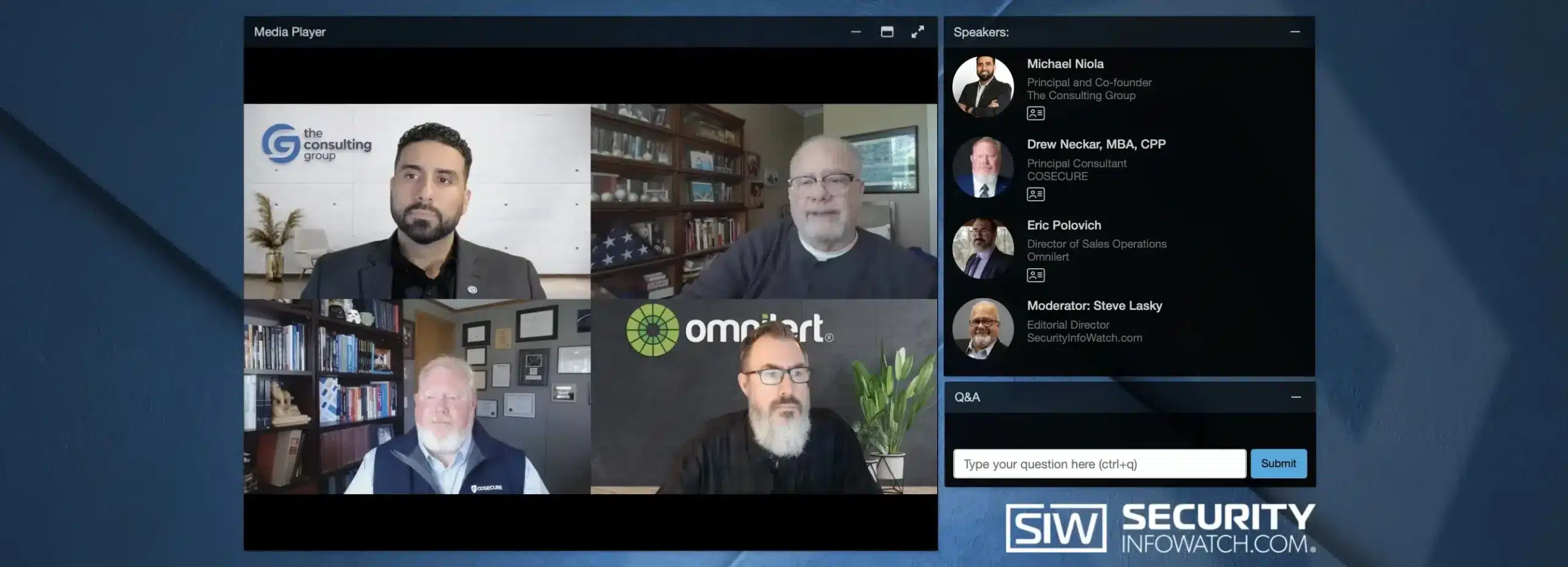
In a recent webinar hosted by SecurityInfoWatch and sponsored by Omnilert and Salient, experts from across security consulting, technology, and operations shared insights into today’s threat landscape and the healthcare and education security trends shaping how organizations stay ahead of emerging risks.
The discussion was moderated by Steve Lasky, the Editorial Director at SecurityInfoWatch, and featured: Michael Niola, a co-founder of The Consulting Group and a specialist in integrated security design for healthcare and higher education environments; Drew Neckar, the Principal Consultant at COSECURE and former healthcare and education security executive; and Eric Polovich, the Director of Product and Partner Enablement at Omnilert and expert in safety technology and gun detection solutions. Together, they explored real-world challenges, emerging technologies, and practical approaches to improving safety outcomes while maintaining the open environments these institutions depend on.
The Shift from Reactive to Proactive Healthcare and Education Security Trends
The webinar began with a conversation about the threat landscape the two industries face today. Both Niola and Neckar commented on how the number, type, and vectors of threats have changed, with threats becoming less predictable and more frequent. They noted that, for years, many organizations have approached security as a post-incident exercise, analyzing what went wrong and how to respond better next time.
But, they agreed, this is changing. Polovich explained that there is a need to turn away from passive awareness and towards active early threat detection and response. Niola highlighted that this shift also seems to be cultural, explaining that the organizations he works with are increasingly focused on prevention, not just deterrence, by using existing data and systems more effectively to identify risks before they escalate.
Why Technology Alone Isn’t Enough
While new tools and innovations continue to emerge, the panel emphasized that technology without strategy often falls short. Neckar finds that many organizations fall into the “shiny object” trap, investing in new solutions without fully utilizing (or understanding) what they already have. He argued that security managers need to look more holistically at the actual risks their organizations face and the resources they have that can address those things, including people, policies, and technology.
“The best tech in the world fails without a plan behind it,” Polovich added. The panelists agreed that effective security requires alignment across technology, people, and process… without integration and coordination, even advanced systems can create noise (rather than actionable insights) which limits their ability to improve outcomes.
The Power of Early Detection and Time
One of the most critical themes discussed was the importance of detecting threats earlier in the timeline of an incident. “Most incidents don’t start at the first shot,” Polovich explained. “If you can detect that threat even a minute or two earlier in the process, you can fundamentally change the outcome.”
He continued that early detection, whether through behavioral cues, surveillance, or community awareness, is essential for creating time. And in emergency situations, time is the most valuable resource organizations have to coordinate response and reduce harm.
Coordination, Not Just Capability
What separates prepared organizations from the rest isn’t just the tools they deploy—it’s how well they coordinate them.
Polovich noted that security breakdowns often occur when response actions happen sequentially, rather than simultaneously. The goal, he stated, is to compress the timeline and enable faster, more synchronized responses across teams and systems.
This requires planning, training, and cross-functional alignment. Neckar emphasized that technologies must “work as a coordinated piece of an organization’s security program to reduce those risks.”
AI, Automation, and the Human Element
The panelists concurred that AI and automation are increasingly playing a role in modern security strategies, but their value depends on how they’re implemented.
Polovich described AI as a “force multiplier,” capable of accelerating detection and reducing manual workload. However, he highlighted that technology should support, not replace, human decision-making. “Bring the person in to make the decision,” he said, “because context matters. Humans give it that judgment.”
At the same time, Niola raised the concern of alarm fatigue, which can happen when technology is not configured adequately and can lead to real flagged events getting lost in the masses of unconcerning ones. He stressed that AI needs to solve a real operational issue, not create one.
Balancing Security with Environment and Experience
Throughout the conversation, it was emphasized that, in both healthcare and education, security measures must be carefully balanced with the need to create welcoming, functional environments.
“The best kind of security… is the one you don’t see,” Niola suggested, highlighting the importance of designing systems that operate seamlessly in the background. He believes that one of the best ways to achieve this is by bringing security personnel into the conversation as early as possible, integrating security considerations in facility design and ensuring systems support broader operational goals, not just security functions.
He emphasized that the data collected from technology should be usable beyond just security… it can provide helpful insights into behavior that may be able to aid HR teams, school counselors, and others in prevention efforts.
Conclusion: Moving Toward Measurable Prevention
Ultimately, the webinar underscored how healthcare and education security trends are pushing organizations to rethink how they define and measure success in security.
As said by Polovich, “It’s not enough to say that you had security measures in place. You really have to show that they’re effective.”
While Neckar explained that prevention can be difficult to quantify, he supported the idea that the focus is shifting toward reducing risk, improving coordination, and demonstrating a proactive commitment to safety.
Neckar summarized: while no organization can eliminate risk entirely, the goal is clear—mitigate threats, act earlier, and build a more resilient, coordinated security strategy.
Omnilert helps bring these healthcare and education security trends to life with solutions like AI-powered gun detection, real-time alerts, and automated emergency response, developed to give organizations more time to act when it matters most. Designed with HIPAA compliance in mind for healthcare and to run in the background without disrupting day-to-day operations in education, our technology aims to provide early detection without impacting the comfort and care these environments promote. Visit our website to request a demo.