


Gun violence shows up in many forms: homicides, suicides, mass shootings, domestic violence, school shootings, and more. While each of these categories has its own causes, risk factors, and prevention strategies, they’re often lumped together because of the weight they carry.
Accurate U.S. gun violence statistics are key to public safety planning, school safety assessments, workplace preparedness, and community-level injury prevention. These numbers determine where resources go, which programs get funded, and how organizations prepare for emergencies.
They also carry a heavy weight, not just in healthcare costs, but in the psychological impact they have on survivors and communities.
This article is meant to be a companion to practical gun violence prevention resources. Prevention is a team effort involving everyone from lawmakers and community leaders to researchers and non-profits. Understanding the scope of gun violence is a strong starting point for anyone wanting to get involved
The Numbers at a Glance
- Early estimates indicate that there were 38,842 gun deaths in the U.S. in 2025 (Gun Violence Archive, 2026).
- 62% of firearm deaths were suicides in 2024 (Pew Research, 2026).
- 35-40% of gun deaths are typically classified as homicides (Pew Research, 2026).
- 186 mass shootings were reported in the first half of 2026 (Gun Violence Archive, 2026).
- In the first half of 2026, 10,586 people were injured by gunfire (Gun Violence Archive, 2026).
- Firearms became the leading cause of death for 1-17 year olds in 2020 and have been for the past few years (Johns Hopkins Bloomberg School of Public Health, 2024).
- Gun suicides increased by roughly 20.1% between 2012 and 2022, despite recent declines in some other forms of gun violence.
- The U.S. firearm homicide rate is approximately 26 times higher than that of other high-income countries (Everytown Research & Policy, 2022).
- All 50 states recorded at least one shooting death during the first six months of 2026.
Gun deaths went up during the pandemic. While overall gun deaths have declined in recent years, firearm violence continues to be a major public health and safety issue.

An Overview of Gun Violence in the U.S.
How many people die from gun violence in the US?
Data places recent annual firearm deaths within a range of 38,000-49,000 per year. Recent years’ numbers include:
- 48,204 gun deaths in 2022.
- 46,728 gun deaths in 2023.
- 44,447 gun deaths in 2024.
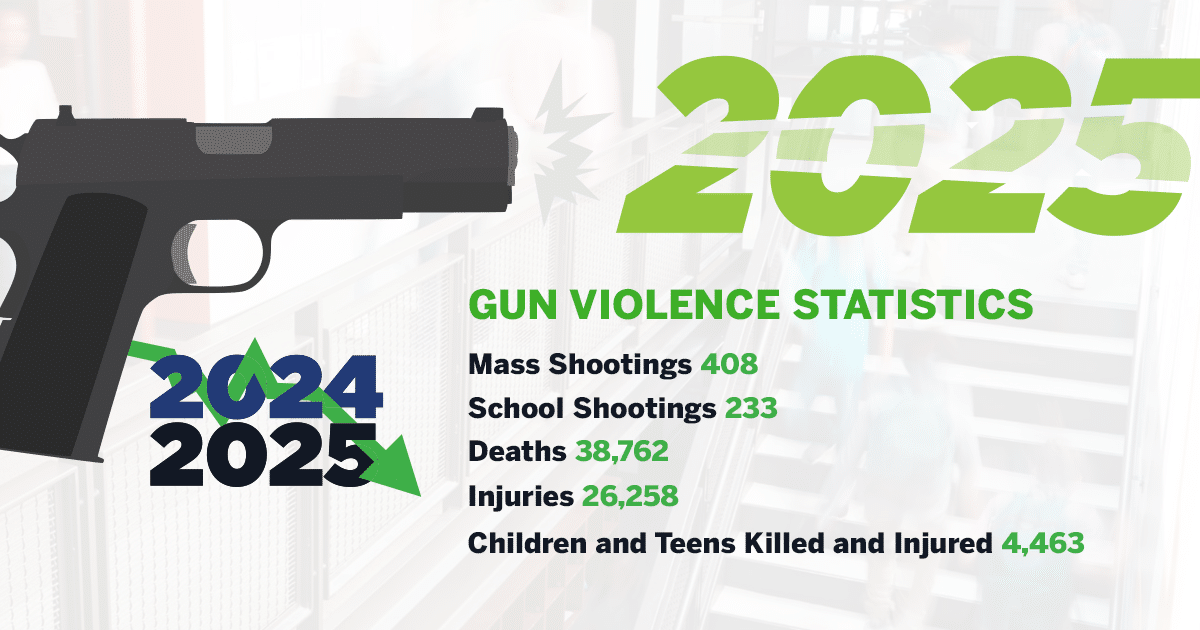
- 38,842 gun deaths in 2025 (GVA early numbers).
These numbers are still very high but show a steady decline since 2021. The CDC has not yet released the official data (official health statistics usually take 12-18 months after the close of a calendar year to be finalized), but preliminary 2025 gun violence statistics suggest the numbers have continued to fall.
CDC estimates suggest that in recent years, nonfatal firearm injuries are at least twice as common as fatal firearm injuries. Emergency department databases have reported treating gunshot injuries at disproportionately high rates among people ages 15-24. Visits by children aged 0-14 increased the most during the pandemic and have remained high in the years since.
What States Have the Highest Rates of Gun Violence?
Mississippi has the highest gun violence mortality rate per capita in the U.S., reaching 22.9 deaths by firearm per 100,000 in 2021. Other states with high rates include New Mexico, Alaska, Alabama, Wyoming, and Louisiana.
The States that have the highest gun homicide rates are similar: Mississippi (18.7), Louisiana (16.7), Alabama (13), New Mexico (11.5), and Missouri (10.3).
When it comes to mass shootings especially, Washington, D.C. has the highest rate per capita. From 2012-2022, the district had a rate of 10.4 mass shootings per million residents. This is followed by Louisiana with a rate of 4.28, Illinois 3.61, and Mississippi 2.91.
Select or Click Your State to Learn More
What Are the Most Common Types of Gun Violence?
Firearm Suicides: 62% of gun-related deaths were suicides in 2024, reflecting a broader trend of suicides overtaking other gun deaths. Suicides are continuing to rise in recent years even as overall gun violence seems to be declining.
Firearm Homicide: Homicide is the second most common type of gun violence. It represents about 35-40% of annual gun fatalities, and data from Pew Research center indicates that 76% of all homicides in the United States involved a firearm.
Mass Shootings: Mass shootings, representing a small fraction of overall gun deaths, are highly impactful. Researchers estimate that they have accounted for about 1% of all gun deaths in recent years, with especially high numbers in the years during and following the pandemic. 2025 saw a 19% decrease in mass shootings from the previous year, with a total of 407 incidents, according to the Gun Violence Archive.
Youth Gun Violence: Mostvictims of gun violence are adults, but children and teens aren’t unaffected. Firearms have become a leading cause of death for American children aged 1 to 17, surpassing motor vehicle crashes starting in 2020. School shootings have been a constant source of stress for parents and kids across the country, but there is hope as both the number of school shootings decreased by up to 30% and the number of K-12 deaths and injuries from these incidents decreased by 26% from 2024 to 2025.
Early signs of progress do not negate the need for gun violence prevention efforts. Even as some health metrics are going down, safe storage, community interventions, mental health support and emergency preparedness are still needed.
What Is the Cost of Gun Violence?
The true cost of gun violence can be difficult to measure.
There are the more concrete numbers:
- $557 billion: The total estimated cost of gun violence in the U.S. every year.
- $2.8 billion: The total estimated cost of immediate and long-term healthcare (both medical and mental)
- $535 million: The total estimated amount employers lose and spend each year due to gun injuries.
- $30,000: The estimated amount spent on each nonfatal firearm injury in the first year.
- $5.8 billion: The estimated amount lost in lifetime earnings per year for school shooting survivors.
But the non-financial losses go beyond this. They encapsulate a lifetime of trauma, stress, and fear felt by survivors, their families and friends, and strangers.
While it’s important to know the numbers, it’s critical that the scope of impact isn’t limited to them.
2026 Gun Violence Statistics (Through June)
We’re at the six-month mark, and early-year data and trends are helping us understand gun violence in 2026. As the year goes on, databases update incident records, and the government eventually releases official firearm mortality data, these numbers will change and evolve. For the most up-to-date numbers, go to the sources directly.
How Many Gun Deaths Have There Been in 2026 So Far?
According to The Trace, shooting deaths (excluding suicides) dropped to 3,103 in Q1 2026. They reported that this was the lowest first-quarter total in over a decade.
GVA’s 2026 numbers show that, as of early June, there have been at least:
- 5,821 gun deaths (excluding suicides).
- 10,586 injuries from guns.
- 186 mass shootings.
All 50 states had at least one shooting death in the first six months of 2026. Some states saw concentrated violence in urban areas and others were mostly affected by firearm suicides in rural areas.
How Many Mass Shootings Have There Been in 2026?
Using GVA’s definition of four or more people shot, Q1 2026 mass shooting numbers appear lower than the same quarter in 2025 and are substantially below the elevated counts of 2021-2023. But numbers for Q1 may shift slightly as databases refine incident records and some shootings initially classified differently are later recategorized.
The numbers also vary by resource:
- Gun Violence Archive: 186 mass shootings
- Everytown – EveryShot: 197 mass shootings
- AP News: 11 mass shootings
- Mother Jones: 2 mass shootings
The reason for this is the criteria. Sources often define different victim thresholds; some count incidents based on fatalities and others on those shot (including wounded). Some databases exclude certain incidents if they’re crime-related (robbery or gang violence) or if they involve domestic violence/familicide, even when they meet victim thresholds, because they track them in a separate subcategory. This results in wide gaps in numbers and can confuse people trying to understand them.
Patterns seen in the first half of 2026 include:
- Concentration of mass shootings in specific metro areas
- A continued share linked to domestic or intimate partner violence
- Larger-scale violent domestic incidents gaining coverage in the media
Youth Gun Violence and School Shootings
As of June 5, there have been up to 99 incidents of guns being brought onto or fired on K-12 or higher ed campuses this year. Omnilert’s article on 2026 School Shooting Statistics aggregates the numbers and information from multiple trackers into one place.
What to Watch for the Rest of 2026
Several factors will impact gun violence trends over the rest of 2026:
- Seasonal patterns: Community violence and firearm-related homicides tend to increase during warmer months.
- Domestic violence and familicide: Economic downturns, stressful periods, and holidays can increase risk for violence within households.
- School-adjacent shootings: Incidents on school grounds, near bus stops, or at after-hours events require school safety planning.
- Active shooter incidents: Workplace, entertainment venues, and houses of worship violence remain a concern for public safety planners.
- New Policies: Policies, such as state-level safe storage laws or Extreme Risk Protection Orders, and changes in funding for community violence intervention programs may all influence outcomes.
More research on 2025-2026 trends will be needed once CDC finalizes annual mortality data.
Why Gun Violence Statistics Vary by Source
Conflicting numbers in news stories or policy debates are rarely due to mistakes. More than likely, they come from different definitions, data sources, and reporting timeframes. For example:
- Definition of gun violence: Some sources include suicides; others don’t.
- Fatal/nonfatal incidents: Some databases only track fatalities; others include incidents involving injuries.
- Mass shooting criteria: Definitions and criteria of mass shooting can change the way incidents are counted. “Four or more shot” and “four or more killed” yield vastly different numbers, and some sources only count incidents where the victims are unrelated to the perpetrator.
- Reporting completeness: Law enforcement participation in federal reporting systems can be spotty from department to department.
- Timeliness: Real-time databases, government data with finalized data, and aggregate sources can yield different results depending on how often and when they are updated.
One source might say there were 14,600 non-suicide shooting deaths in a given year, while CDC reports over 44,000 total firearm deaths including suicides for that same year. They can both be right; they’re just measuring different things.

Types of Gun Violence
Forms of gun violence differ widely in their causes, victims, risk factors, and prevention strategies. Understanding these different forms of firearm violence and how they have changed over time provides important context for interpreting gun violence statistics and guiding effective prevention solutions.
Firearm Suicide
Firearm suicides make up the largest share of gun deaths in the United States. They represent roughly 55-60% of firearm fatalities in a typical year. Despite its prevalence, suicides often receive less public attention than other forms of gun violence.
Over the past decade, firearm suicides have increased significantly. From 2002 to 2018, the age-adjusted firearm suicide rate went from around 10.9 to 14.2 deaths per 100,000 people, and the total number of firearm suicides increased by roughly 30%. In recent years, firearm suicides have continued to make up a growing share of total gun deaths, even as some other categories declined.
Risk factors include:
- Acute personal crises
- Certain mental health conditions (major depression, bipolar disorder, etc.)
- Substance misuse
- Social isolation
- Easy access to loaded firearms
Older adults, veterans, rural residents, and individuals with readily accessible firearms are also at higher risk. Firearm suicide attempts are particularly lethal, with approximately 85% resulting in death, compared to less than 3-5% for many other methods.
Effective suicide prevention focuses on reducing access to lethal means during periods of crisis through safe firearm storage, temporary off-site firearm storage, lethal means counseling, and access to crisis intervention services such as the 988 Suicide & Crisis Lifeline. It’s important to remember that prevention efforts should always focus on support and risk reduction over stigma.
Firearm Homicide
Community violence, interpersonal disputes, robberies, gang- or group-involved shootings, and domestic violence incidents can all contribute to gun homicides. Compared with other high-income countries, firearm homicide remains disproportionately high in the United States. According to Everytown, the U.S. firearm homicide rate is 26 times higher than other high-income nations.
Historically, firearm homicide rates have fluctuated a lot. Rates were high from the 1970s through the early 1990s, peaking with broader violent crime trends and exceeding 10.2 deaths per 100,000 people in some years. From the mid-1990s through the mid-2010s, firearm homicide rates declined significantly, reaching a modern-era low of approximately 3.8-4.0 per 100,000 by 2014.
The COVID-19 pandemic period reversed much of that progress. CDC data shows firearm homicide rates rose sharply between 2019 and 2021 before declining again. By 2022, the age-adjusted firearm homicide rate remained elevated at approximately 6.2 per 100,000 people, but varied greatly by community.
Researchers have identified many factors associated with higher firearm homicide risk, including concentrated poverty, neighborhood disadvantage, social instability, and unequal access to resources and opportunities.
Domestic and Intimate Partner Violence
Domestic and intimate partner violence is a major contributor to firearm fatalities in the United States. The presence of a firearm in a home significantly increases the likelihood that an act of intimate partner violence will become fatal.
These incidents often involve multiple victims, including children, family members, and bystanders, and may overlap with broader categories like familicides, femicides, or mass shootings. Since domestic violence often precedes more severe violence, many prevention efforts focus on early intervention, survivor support services, protective orders, and firearm relinquishment when legally mandated.
Mass Shootings
Mass shootings get a lot of media attention and often shape public perceptions of gun violence. However, they account for only a small fraction of overall firearm deaths.
While public mass shootings involving attacks on strangers in schools, workplaces, or public spaces get the most coverage, many mass shootings actually come from domestic violence, interpersonal disputes, or community violence.
Definitions vary widely across organizations, which can produce vastly different numbers. Using Gun Violence Archive’s definition of four or more people shot (injuries and fatalities), the number of mass shootings increased from fewer than 400 annually in the mid-2010s to up to 689 incidents in 2021. During the same period, FBI data show active shooter incidents peaking at 61 in 2021. Databases that use stricter definitions, like four or more fatalities, report much lower numbers.
When comparing mass shooting statistics across sources, you need to understand which definition is being used.
Mass shootings comprise a small percentage of firearm deaths but have a big impact on society. One survey found that 79% of U.S. adults report stress related to the possibility of a mass shooting. Research has shown that many perpetrators have a history of personal grievances, domestic violence, or major life stressors, and a very small percentage suffer from severe psychotic disorders.
Youth Gun Violence and School Shootings
Firearm violence is a major public health concern for children and adolescents. In 2020, firearms surpassed motor vehicle crashes as the leading cause of death among Americans ages 1-17.
While youth firearm deaths have declined slightly in recent years (from 3.5 to 3.0 deaths per 100,000), they’re still at very high levels. Not all young people carry the same burden of firearm violence. Firearm homicide disproportionately affects Black children and adolescents, at rates more than 10 times those of their white counterparts.
Firearm suicide among youth has also increased, up by about 41% among 10- 24-year-olds from 2014 to 2023.
School shootings are a highly visible aspect of youth firearm violence and include active shooter attacks, targeted assaults, accidental discharges, and shootings that occur on or near school property. While high-fatality school shootings are rare events, repeated exposure to gun violence in school-adjacent contexts may have significant consequences for students’ perceptions of safety, mental health, and educational outcomes.
Unintentional shootings involving children often result from unsecured firearms in homes. Safe storage practices (keeping firearms locked, unloaded, and stored separately from ammunition) remain one of the most effective prevention strategies for reducing youth firearm injuries and deaths.
Violence in the Workplace
Workplace gun violence may take many forms, such as employee disputes, violence involving former employees, domestic violence that spills over into the workplace, customer or client violence, and targeted attacks.
While large-scale workplace mass shootings are uncommon, more common incidents involving armed robberies, interpersonal conflicts, and workplace disputes contribute to firearm injuries each year. These risks highlight the importance of workplace violence prevention programs, employee training, threat assessment processes, and emergency communication systems.
Accidental and Unintentional Shootings
Accidental firearm deaths account for approximately 1% of firearm fatalities in the United States, but nonfatal accidental shootings occur much more frequently. Often, these incidents are caused by the mishandling of firearms, unsafe storage or cleaning, or children getting access to unsecured firearms.
Children are disproportionately affected by accidental shootings, especially those involving firearms that are stored loaded and unlocked in homes. Preventing these incidents is a matter of safe storage practices and firearm safety education.
Officer-Involved Shootings and Legal Intervention
Some firearm fatalities are classified as legal intervention deaths, referring to shootings involving law enforcement officers in the line of duty. These account for roughly 1.4% of all gun deaths in the U.S.
However, tracking officer-involved shootings remains difficult because reporting practices vary from jurisdiction to jurisdiction and database to database. Comparisons of statistics between sources are hard because of differences in methodology, classification standards, and legal aspects.

Factors That Influence Gun Violence
While each type of gun violence has distinct causes and risk factors, research has identified several factors that appear across multiple forms of firearm violence.
- Changes in Mental State: Certain mental health conditions and acute crises significantly raise suicide risk when lethal means like firearms are present.
- Substance Use: Alcohol and drug use are frequently present in both interpersonal shootings and gun suicides, increasing impulsivity and lowering inhibitions.
- Social and Economic Factors: Poverty, housing instability, social isolation, youth exposure to violence, firearm access for domestic abusers, and limited access to resources are associated with higher rates of firearm violence in some communities. These factors can increase both victimization and perpetration risks.
- Firearm Access and Storage: Household gun ownership levels and how firearms are stored are closely linked to risks of gun suicide, accidental shootings, and certain types of homicide. Safe storage practices can reduce risk, particularly for children and individuals experiencing a crisis.
- Seasonal and Geographic Patterns: Gun homicides and assaults often increase in warmer months. Urban centers experience higher firearm homicide rates, while rural communities face higher gun suicide rates. State-level variation is dramatic: Mississippi and Alaska have age-adjusted firearm death rates above 23 per 100,000, while Massachusetts and Connecticut fall below 7 per 100,000.
- Gun Markets and Trafficking: Theft, trafficking, and illegal firearm markets contribute to the movement of firearms used in criminal activity and may influence local violence patterns.
Understanding what things can influence gun violence is only part of the picture. Public perception is also very much influenced by how firearm violence is reported and discussed in the media.
Gun Violence Coverage By the Media
Media coverage shapes how the public understands gun violence statistics, often highlighting dramatic but rare events while underreporting the larger toll of everyday shootings and suicides.
National media tends to devote substantial attention to public mass shootings in schools, workplaces, and entertainment venues. While coverage of these tragedies is critical, the disproportionate focus can distort public perceptions of how most gun deaths actually occur. The much larger toll from daily gun homicides, domestic violence, and firearm suicides receives comparatively little coverage.
When sensational incidents are all that are focused on, the public can tend to overestimate the frequency of mass shootings and underestimate the scale of gun suicide and community gun violence. Sensational coverage may also amplify contagion risks and copycat incidents. At the same time, inconsistent definitions across outlets and databases can contribute to confusion.
Best practices for reporting firearm violence include using precise definitions, clearly naming data sources, covering context, including prevention resources, highlighting community-led solutions, reporting on declines as well as spikes, and not identifying perpetrators unnecessarily.
How U.S. Gun Violence Compares To Other Countries
International comparisons consistently show the U.S. as an outlier among high-income nations when it comes to gun violence and gun-related homicides. But these comparisons need to be interpreted carefully.
U.S. firearm mortality rates are many times higher than those of other high-income countries. Among the most populous high-income countries, the U.S. accounts for a disproportionate share of firearm deaths.
- Firearm Homicides: A report from the Council on Foreign Relations found that the gun homicide rate in America is much higher than in European countries, Canada, Australia, and Japan, even when overall violent crime levels are similar. This gap is partly due to higher civilian gun ownership and different gun laws and policing strategies.
- Firearm Suicides: There are many studies that show firearm availability affects suicide lethality. Countries that restrict access to guns, like Australia and the U.K., have lower firearm suicide rates and often lower overall suicide mortality.
- Child and Teen Firearm Deaths: U.S. kids and teens face gun death rates far higher than their peers in other wealthy nations, especially from firearm homicide. This is because of the unique combination of high gun availability and social factors that exists in the U.S. but not other high-income countries.
What International Comparisons Can and Cannot Prove
International comparisons are important but shouldn’t be oversimplified as proof that one policy alone explains the difference. Every country has different laws, culture, policing, health care systems, social safety nets, and data collection methods. Each of those things can affect outcomes. Comparative data should be thought of as one piece of evidence and local research and evaluation of specific interventions should be considered with it.

Prevention Efforts and Evidence-Based Strategies
Gun violence statistics aren’t just numbers; they point toward prevention opportunities at the community, household, and policy levels.
Prevention strategies aren’t standalone solutions. They need to work together as a system with a common goal, supporting a culture of prevention.
Community Violence Intervention
Community violence intervention (CVI) models, including street outreach, hospital-based violence intervention programs, and focused deterrence, target the highest risk groups and individuals in a community. Evaluations in several cities show reductions in shootings and gun homicides when programs are well-resourced and sustained.
Suicide Prevention and Safe Storage
Lethal means counseling in healthcare and crisis settings, encouraging families to store guns locked and unloaded, and temporary off-site storage during high-risk periods are evidence-backed strategies. Crisis hotlines, mobile crisis teams, and expanded behavioral health services all help to reduce gun suicides.
Domestic Violence Prevention
Studies show that policies restricting gun access for people with domestic violence convictions or restraining orders may prevent violent escalation and gun deaths. Outside of legal interventions, coordinated community responses can help protect survivors. This means supporting survivors and offering shelter access, legal aid, and threat assessment for high-risk cases.
School and Workplace Violence Prevention
Schools and workplaces can use anonymous reporting systems, behavioral threat assessment teams, and robust emergency communication tools to help identify and respond to threats before they escalate.
Realistic risks should guide training, trauma-informed drills, and physical security measures. While it may seem better to prepare just for the worst-case scenario, everyday risk should also be considered.
Policy Approaches
Firearm safety regulations are usually left to the states to decide. Researchers and public health organizations have found evidence for:
- Comprehensive background checks
- Firearm purchaser licensing
- Safe storage and child access prevention laws
- Extreme Risk Protection Orders (ERPOs)
- Lost/stolen gun reporting requirements
- Domestic violence firearm restrictions
- Community prevention funding
State-level variation in these policies contributes to differences in firearm homicide and suicide rates across the U.S.
Technology and Emergency Communication
Organizations across the country are using technology to prevent and reduce the impact of shootings. Tools like gun detection systems, mobile panic buttons, and multichannel mass notification platforms are helping detect gun threats earlier, respond faster, and coordinate with law enforcement. Organizations using tech should integrate it with human-centered threat reporting, training, and recovery plans rather than relying on tools alone.
Gun Violence and Public Safety Planning
Schools, workplaces, hospitals, campuses, houses of worship, and event venues should use up-to-date gun violence statistics to inform risk assessments, training, and emergency plans. A balanced approach recognizes both the rarity of some extreme events and the real need to prepare for them, while focusing on everyday injury prevention, detection, and post-incident recovery.
Leaders should talk with local law enforcement, public health agencies, and community groups to align their strategies with broader gun violence prevention efforts and ensure that preparedness planning reflects actual local risks.
Conclusion
U.S. gun violence statistics describe multiple overlapping problems-gun homicide, gun suicide, domestic violence, youth shootings, and mass attacks-each with distinct patterns and prevention pathways. Preliminary data from 2025 and early 2026 show encouraging declines from pandemic-era peaks in firearm homicide and nonfatal shootings, but gun suicides, youth exposure, domestic violence, and disparities remain urgent concerns.
Readers should consult multiple data sources, pay attention to how each defines and measures gun violence, and use statistics to guide evidence-based prevention strategies in homes, communities, schools, and workplaces. The numbers by themselves cannot capture the full human toll, but they remain the most powerful tool we have for understanding where the problems are worst-and where solutions can make the greatest difference.
Frequently Asked Questions (FAQs)
How accurate are gun violence statistics I see in the news?
Most major outlets get their numbers from CDC, FBI, GVA, or established research organizations. But headlines often leave out caveats about definitions and data lags. Always check if numbers are all firearm deaths or just gun homicides, and if the source is a real-time database or final government data. The difference matters: One source may show that there have been 18,000 non-suicide shooting deaths, while later CDC reports show 44,000 total firearm deaths for the same year. Both counts are important, but they track different things.
Are suicides included in gun violence statistics?
This depends on the source you are looking at. Government-published data from the CDC tends to be the most comprehensive, covering all gun deaths including suicides. However, its data gets published with a lag time of over a year sometimes, so it isn’t a great option for real-time numbers. Gun Violence Archive is often the go-to for real-time data as it gets updated daily, but it doesn’t track suicide until official end-of-year data is made available. Other sources like Everytown’s Everytshot do track suicides, but it is always important to confirm the source’s inclusions when citing numbers.
What do gun violence statistics say about domestic violence?
A large share of women killed with guns in the U.S. are victims of intimate partner violence; firearms increase the likelihood of abuse turning fatal. Many domestic violence-related shootings also involve other family members or children, so they may be part of both homicide and mass shooting stats. Policies like mandatory firearm surrender for people under domestic violence restraining orders are designed to address this risk.
What industries is Omnilert’s gun detection system suitable for?
Yes, Omnilert’s gun detection system is designed to support a wide range of environments, including enterprises, hospitals, K–12 schools, higher education campuses, corporate campuses, distribution facilities, casinos, public transportation, stadiums, venues, houses of worship, public spaces, and more. Its scalable architecture and privacy-focused design make it well-suited for organizations seeking proactive safety without disrupting daily operations.
Where can I find the latest gun violence numbers?
CDC WONDER/WISQARS is the go-to source for official government data, but numbers are updated with a lag of 12-18 months. For daily and yearly shooting tallies, Gun Violence Archive is a strong resource, but suicide numbers are often not counted and can impact numbers overall. For quarterly U.S. gun violence statistics and analysis, The Trace Gun Violence Data Hub is a helpful resource. Supplement with reports from academic centers, public health agencies, and nonpartisan research groups that interpret the data and provide context on trends and prevention strategies.
Why do different sources report different numbers?
Different definitions of gun violence, different mass shooting thresholds, inclusion or exclusion of suicides, and differences in reporting lag and completeness all contribute to sources having number disparities.
What are the most effective prevention strategies?
Evidence supports community violence intervention, safe storage programs, lethal means counseling, domestic violence firearm relinquishment, Extreme Risk Protection Orders, and comprehensive background checks. Different types of gun violence require different approaches.
Gun Violence Statistics by Year

The Latest From Omnilert
 Article
The Rising Cost of Active Assailant Insurance and How Gun Detection Can Reduce Risk
Active assailant events can create costs that extend far beyond physical damage. Organizations may face liability claims, business…
Read Article
The Cost of Gun Violence: Proactive Solutions Reduce the Risk
The economic impact of gun violence is staggering, costing the nation an estimated $557 billion annually—equivalent to 2.6% of…
Read Article
