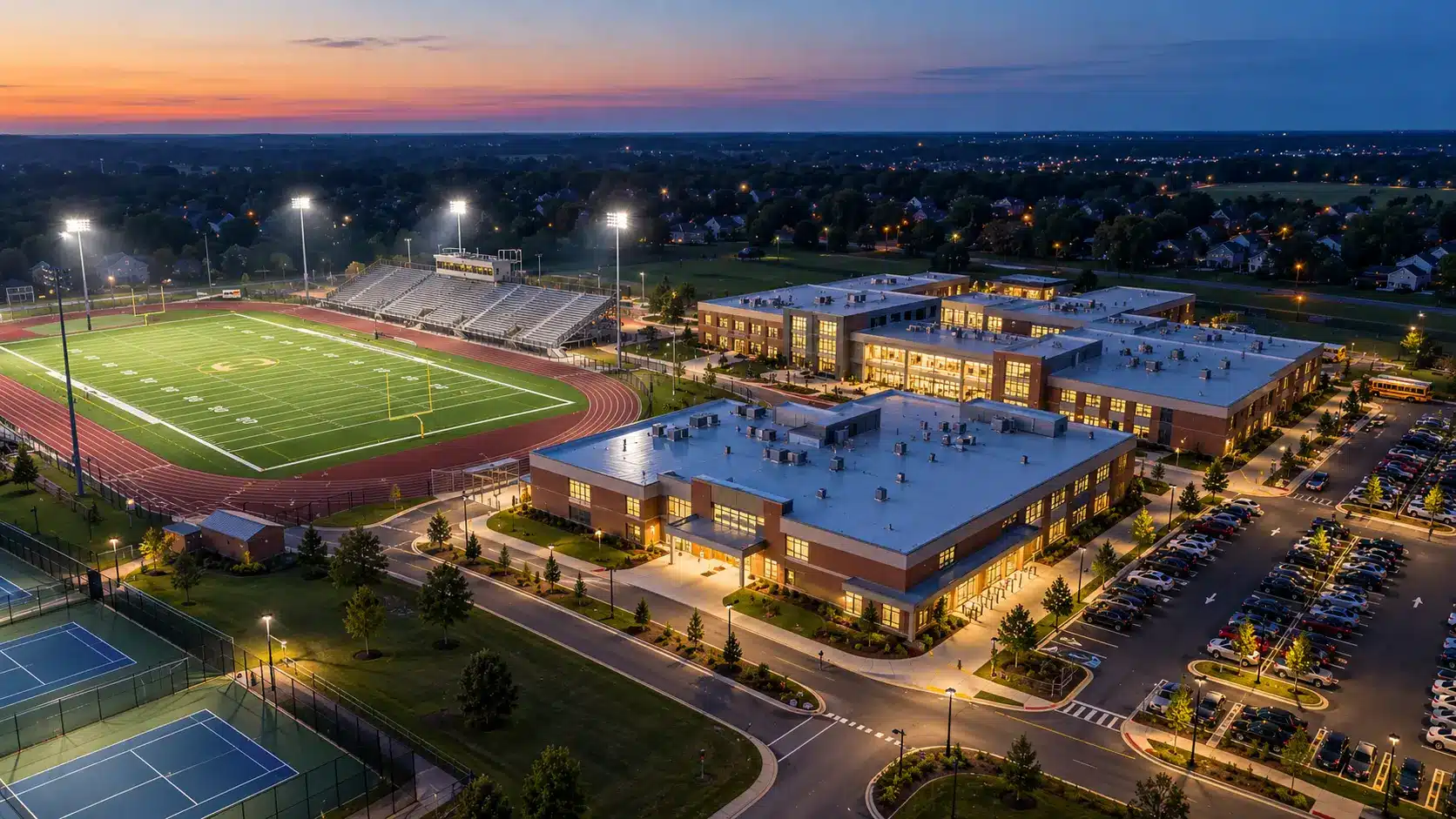
When the School Day Ends, the School Security Environment Changes
It’s a Friday night in October: the marching band is warming up behind the end zone, kids are chasing each other around the concession stand, visiting families are scanning the fence line for the away entrance, and school buses share the parking lot with a steady stream of family vehicles. These scenes play out at thousands of campuses every week in the fall. In 2025–26, the NFHS reported more than 8.4 million high school sports participants, a record topping the previous years’. That figure looks just at students, and only hints at how many people actually show up on game night.
School security procedures are often designed around the more predictable routines of the regular school day, when many campuses are closed environments. In 2021–22, 97% of U.S. public schools reported controlling access to buildings during school hours, and monitoring access to school buildings remains one of the most widely used safety measures nationwide. But when the final bell rings and the stadium lights come on, those controlled conditions change dramatically. Additional gates open, portable ticket booths appear, parking lots fill, and the campus serves a public audience that may never have set foot on the grounds before.
This article considers these challenges and offers practical guidance for administrators, athletic directors, facilities teams, school resource officers, and event security partners preparing for football games, homecoming, graduations, tournaments, and performing arts showcases. It also applies to any district working to create supportive learning environments that extend beyond the classroom.
Key Takeaways
- Evening school events introduce unfamiliar visitors, open access points, and after-dark operations that demand a security plan separate from day-to-day campus routines.
- Mapping the full event footprint, checking camera visibility under game-night lighting, and preparing layered communication channels are core practical steps every district can take.
- Schools should assign clear roles, train volunteers, rehearse handoffs, and prepare for incidents ranging from medical emergencies to targeted violence using both human-led decisions and supporting technology.
- Departure, student accountability, and post-event debriefs are just as important as pregame preparation and should be carried out before the next event.
- Tools like camera health monitoring, AI gun detection, emergency notification systems, and automated workflows can support a coordinated school event security plan without replacing human judgment.
Why School Event Security Needs Its Own Plan
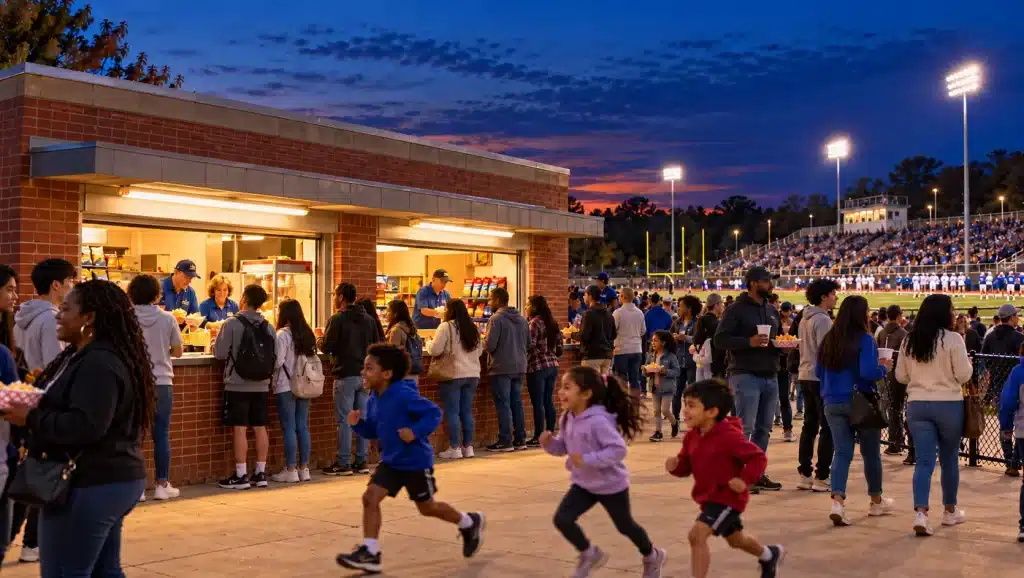
During a typical school day, staff may know every student by name or face. Controlled access points limit entry so visitors have to pass through a monitored main entrance, and routines are predictable. What changes after 4:00 p.m.?
A Friday night game can replace schools’ typical population with alumni, grandparents, younger siblings, visiting teams, and community members who rarely visit campus. These visitors can be unfamiliar with exits, campus terminology, alert tones, and reunification locations, making school safety topics like signage, plain-language instructions, and accessible communication far more important.
But it’s not just routines and faces that change. Staffing shifts, too. Administrators stay beyond their usual hours, teachers take on extra duty, contracted security fills gaps, and volunteers handle gates and concessions. At least 97% of public schools lock or monitor doors, and around 65% of public schools have a school security staff member or school resource officer on site at least once per week. Yet, those daytime resources don’t automatically extend into evening operations. And schools have to also plan for people with mobility impairments, sensory sensitivities to loud noise or bright lights, and language differences among visiting families.
Mapping the Full Event Footprint Before Assigning Security
Before assigning a single staff member, walk the entire site and create an event map that extends well beyond the stadium, field, gym, or auditorium: look at parking lots, drop-off loops, sidewalks, ticket queues, concession stands, restrooms, locker rooms, and any nearby academic buildings.
Perimeters should be secured with fencing and adequate lighting to deter unauthorized intruders, and privacy fence screens can be used for school perimeters where sightline control matters. Also, As more schools adopt digital visitor management systems, requiring visitors to provide identification can add another layer of security and accountability.
Categorize spaces into public areas (stands, concessions), participant-only zones (locker rooms, warm-up fields), and closed areas (classroom wings, administrative offices). Temporary fencing, booster tents, and parked team buses can unintentionally block sightlines or hide poorly lit corners. Even mantrap doors, effective during school hours, serve a different role when hundreds of people flow through open gates.
Break the event into operating phases-arrival, pregame buildup, halftime circulation, and postgame departure, because crowd density and movement differ in each. Establish clear, simple location names like “North Gate” or “Band Tunnel” that staff, dispatchers, and first responders can use consistently. Schools must coordinate closely with first responders regarding layout and emergency procedures well before kickoff, sharing maps and terminology so preplans match.
Football Security: Getting Spectators Safely From Parking Lot to Stands
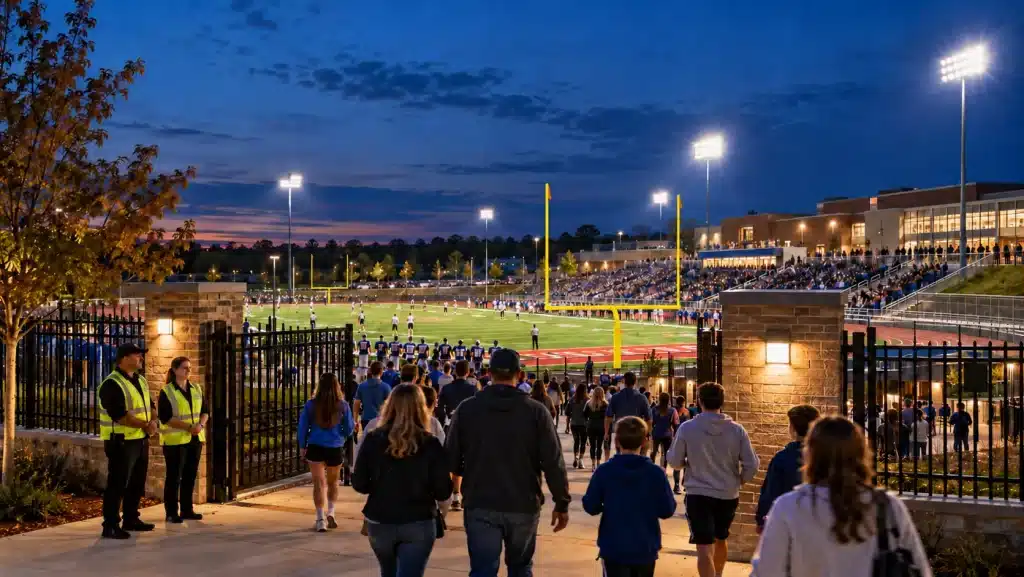
With over 1,047,000 student participants in 11-player football alone (the most of any sport) for the 2025-26 school year, the sheer number of games each week puts a huge demand on facilities and programs. And football security starts long before anybody reaches their seat. Ticketing, bag policies, and screening have to be coordinated so lines move smoothly.
Addressing the Need to Detect Weapons Without Disruptions
As of 2022, only around 2% of US schools use metal detectors daily. Even when schools use them during regular school hours, traditional screening methods may not extend to outdoor sporting events. According to a recent article from CNN, shootings at school football games and homecoming events have become more common in recent years. Since 2008, 27% of school shootings in October and 23% of those in September occurred in connection with football or homecoming events.
These two factors (the limitations of traditional weapons detection methods and the increase in gun violence at events) paired together indicate the need for more flexible weapons detection systems that can help to identify threats without creating bottlenecks for screening. One possibility is integrating AI gun detection into schools’ event security. This technology functions by running on existing security cameras and scanning footage for features that match firearms. When a suspected gun is identified, the detection is sent for verification to trained security personnel or administrators who can use their judgment to escalate or dismiss the situation.
When visible firearm threats can potentially be flagged earlier, response actions (like activating security workflows, initiating a lockdown, or calling first responders) are given more time.
Things to Keep in Mind Before The Game Starts
Games attract a range of people. Everyone should be able to enter and enjoy the game safely, so different arrival flows need to be considered:
- Student sections arriving in groups
- Families with young kids
- Band and cheer buses
- Visiting teams and officials
- Disabled spectators needing accessible routes
To help maintain security and avoid confusion,reentry rules should be communicated in advance through school websites, social media, and printed signage.
Before events, there may be tailgating, pre-game rituals, assemblies, and other things that cause people to gather at or near the field. Emergency exits and responder access routes must remain clear even when crowds congregate near popular gates, so this is something that should be planned for in advance. Always supervise parking areas before kickoff and until spectators have dispersed and the area is secured.
Schools can also turn to frameworks like CISA’s Mass Gathering Security Planning Tool for guidance on bringing together school, law enforcement, fire, EMS and venue stakeholders to develop safety and security plans.
Seeing Clearly After Dark: Visibility, Lighting, and Camera Health
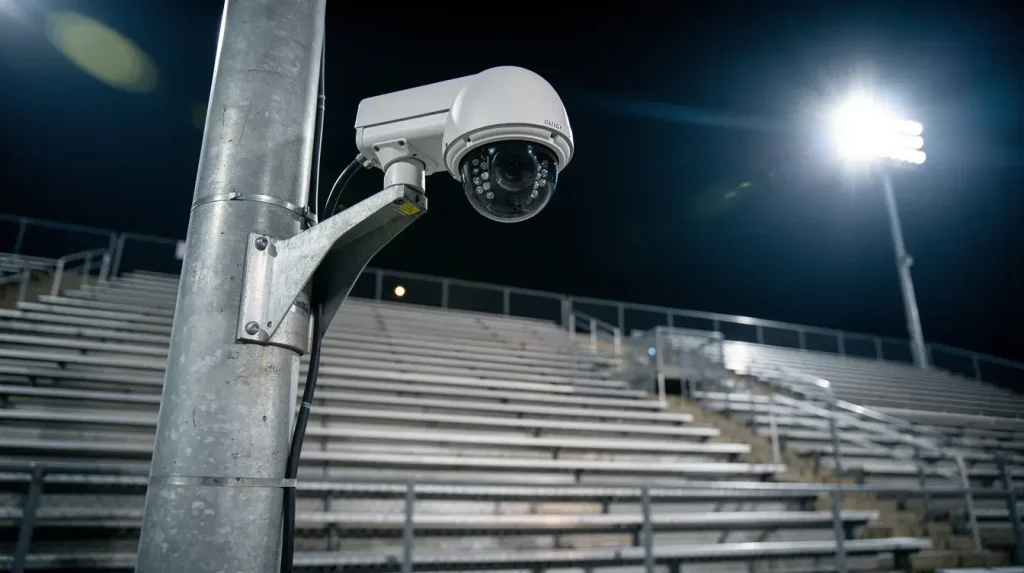
Imagine what your cameras might show at 8:30 p.m. on the night of a game: stadium lights can create glare, car headlights may wash out sensors, and walkways behind bleachers can disappear into the darkness.
According to the National Center for Education Statistics mentioned earlier, at least 93% of schools in America used security cameras in 2022 (and this number is likely higher today). These cameras cover areas both inside and outside of school buildings, often including sports fields, concession stands, parking lots, and gates. But just because a camera is there and online doesn’t guarantee it’s usable.
Schedule a pre-season evening review with security, facilities, and IT staff to look at real camera views under game-night conditions. Looking at both footage and the physical camera can help reveal blur, focus issues, obstructions from new banners or overgrown vegetation, or other issues. As these conditions can change rapidly, it’s important to routinely conduct checks. AI Camera Health Monitoring automates this process by flagging defocused images, blocked lenses, changed fields-of-view, or inadequate lighting so staff can investigate and correct before it matters.
Follow a simple 5-step process: define the purpose of each camera, assess the image quality under representative conditions, investigate the cause (dirty dome, mis-aimed mount, burned-out bulb), correct the issue, and reassess to confirm it’s ready.
Ultimately, knowing if your cameras are usable is an important assurance layer in your security operations. Cameras today are used to support many things. AI-assisted video analytics can help monitor for weapons, but are most effective when the underlying image is clear. Many investigations rely on video or image evidence for support. Finding out that your footage is unusable when you need it most can be detrimental.
Planning for Medical, Weather, Conflict, and Targeted Violence Incidents
While targeted violence and active shooter situations are some of the most serious school safety concerns, emergency planning should also address the incidents that happen more frequently at high school football games. From medical emergencies and severe weather to fights in the stands or parking lots, schools need to have procedures ready for different scenarios and for managing large crowds.
Medical Emergencies: Heat-related illness, cardiac events, falls, and sports injuries require immediate attention. Schools should have trained medical personnel or designated first responders on site, accessible first aid supplies and AEDs, and clearly marked emergency vehicle routes. Staff should know how to contact emergency services and direct them to the incident.
Severe Weather: Lightning, thunderstorms, extreme heat, and other hazardous conditions can put players, staff, and spectators at risk. Schools should monitor weather before and during the game, have clear criteria for suspending play, and identify safe shelter locations. Evacuation or shelter instructions should be communicated through the school’s public address system, digital signs, or other available channels, and procedures should be outlined for when activities can resume. The National Weather Service recommends waiting at least 30 minutes after the last thunder before resuming outdoor activities.
Conflicts and Crowd Disturbances: Disputes in the student section, confrontations between spectators, and fights in the parking lot can escalate quickly. Schools should have trained security personnel or event staff in high-traffic areas, procedures for reporting and de-escalating conflicts, and pre-established coordination with local law enforcement when necessary. Staff should feel confident about when to separate individuals, restrict access to the area, or call for additional help without putting themselves or bystanders at risk.
Targeted Violence and Active Shooter Incidents: Schools should have clear procedures for identifying and reporting potential threats, initiating emergency notifications, and coordinating with law enforcement. In situations like these, prevention is just as important as planning for incidents. Access to counselors, mental health professionals, multidisciplinary threat assessment teams, and confidential reporting systems can help schools identify concerning behavior and intervene before situations escalate. School resource officers can potentially play a role here in preparing for events and deterring violence; beyond regular event duties, they can also facilitate gang-resistance programs like G.R.E.A.T. or teach drug-abuse prevention through D.A.R.E. (both factors that may influence the likelihood of violence). During an incident, staff should follow established emergency response protocols including evacuation, sheltering-in-place, or lockdown procedures based on the location and nature of the threat.
Across all four scenarios, planning must account for both the initial incident and the chaos that follows. Schools should clearly define who receives reports, evaluates the information, calls 911, communicates with spectators, and has the authority to suspend or end the event.
Getting Emergency Instructions To Visiting Families
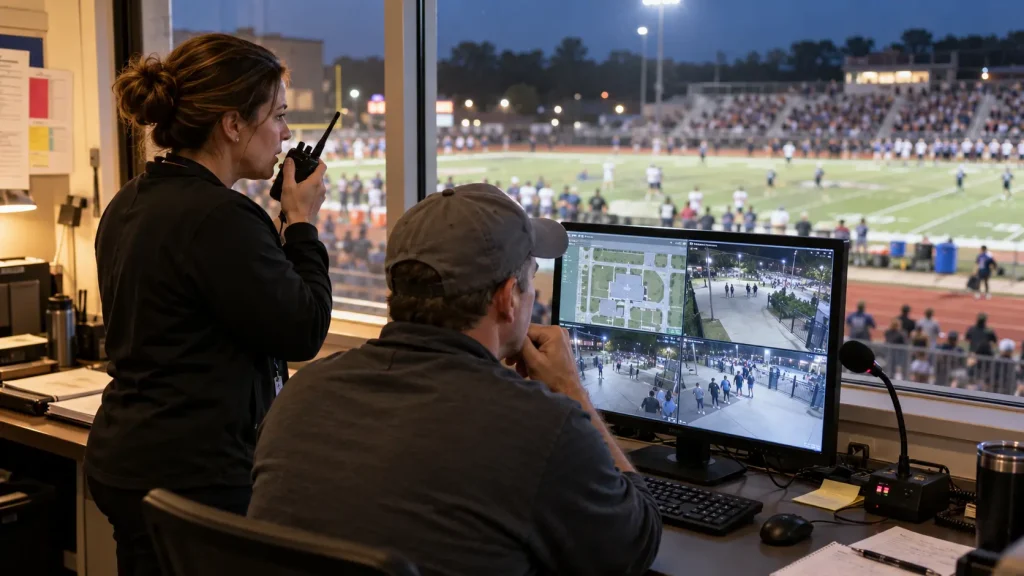
Many people at large events may not be enrolled in the district or school’s emergency notification system (ENS), and clear communication is key during emergencies. A layered approach to communication might include stadium PA, scoreboard messaging, staff radios, megaphones, and an ENS that can send multi-channel alerts.
Prepare pre-approved message templates using location-based language (for example, “Move to the main gym through the ‘X’ gate now”), rather than relying solely on internal codes. Address accessible and multilingual communication needs with visual, audible, tactile, and bilingual announcements where the school community needs them. Test announcements from the stands, restrooms, concessions and parking lots before the season to make sure they can be heard.
Always plan for backup: consider using a battery-backed PA, analog radio channels, and runners to restrooms and concession stands. The Department of Education estimates that schools are experiencing an average of 5 cyber incidents a week, so cybersecurity should be part of the broader emergency plan to keep digital notification systems secure.
Crisis plans should outline communication about procedures for lockdowns, evacuations, and family reunification. Schools should identify primary and alternate reunification locations in advance, establish procedures for verifying authorized caregivers, and prepare clear instructions for directing families to the appropriate location when it is safe to do so.
Assigning Roles, Training Staff, and Rehearsing the Plan
Even the best school event security plan can fail if people don’t know their roles. Assign specific duties to staff and volunteers before events:
- Event lead
- Security lead
- Medical and EMS liaison
- Communications lead
- Student accountability lead
- Contact for visiting teams and officials
Regularly updated emergency operations plans are essential to school security. School safety programs should use multiple layers of prevention and preparedness, not one single solution.
One way to support volunteers and temporary staff is with a one-page briefing document before each event covering how to report concerns, what not to do, and who their supervisor is. Having an office of safety and security can promote emotional safety in schools, and crisis management teams help schools address emotional well-being factors that impact how staff interact with anxious parents and students.
School safety programs can include behavioral threat assessments and emergency drills, and regular talk-through exercises may help staff and students to feel more ready during high-stress events. Running a short tabletop exercise (30 to 45 minutes) before the season, walking through a weather delay, medical emergency, and suspicious person report using radios and notification tools can all help support preparedness.
Keeping the Plan Active Through Departure and Post-Event Review
After the clock hits zero, school security doesn’t just stop. Students may stick around, families will be looking for their cars, and parking lots can still be crowded for a half hour or more. Even if the event has gone smoothly, keep security staff and volunteers around during departure.
When there is a major event, try to debrief within the next few days. Document the key details, like where lines formed, what messages were hard to hear, and if staff had clear visibility of the incident.
Follow-up actions (i.e., fix lighting, update maps, revise scripts, or adjust camera focus) should be assigned to relevant staff members with clear deadlines so that the changes are made before the next event.
Here’s a checklist to assess before the gates open:
- Are entrances, exits, and responder routes ready?
- Have staff and volunteers received their assignments?
- Are all camera views usable under current conditions?
- Can instructions reach visitors outside the district’s contact database?
- Are incident decisions, communication responsibilities, and backup procedures clear?
- Does the plan cover departure and reunification?
Conclusion: Designing School Security for the Campus You Operate on Game Night
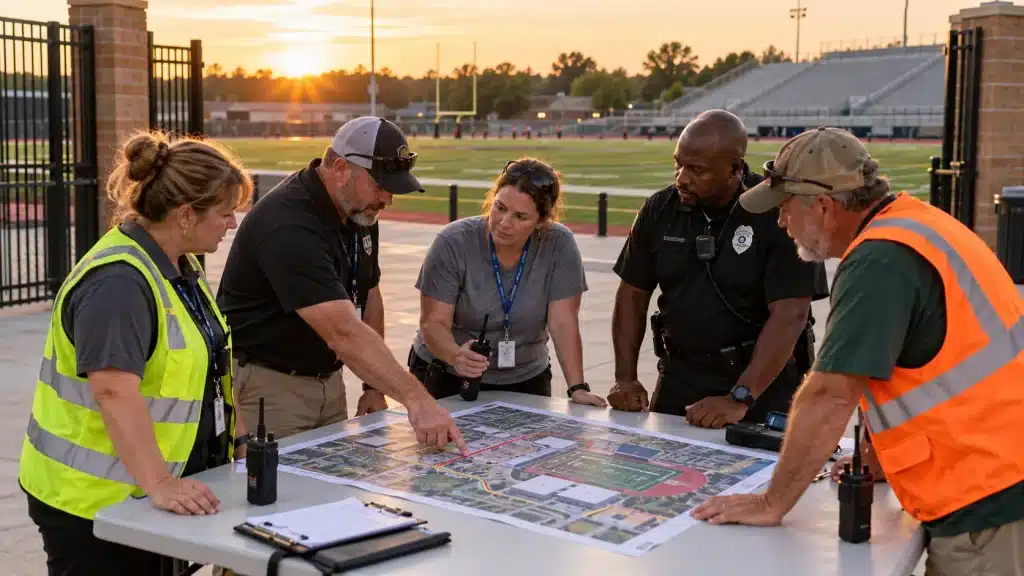
Friday night football, homecoming games and dances, and other Fall events are at the heart of American school culture. Thoughtful school security planning helps protect those traditions without overshadowing them. Schools should always aim to create a culture of trusting relationships where families feel welcome and safe, and that extends to how campuses are operated on game night.
Modern school event security is shaped by people, procedures, and technology. Layered security architecture, combining physical safety, digital protections, and human intervention, supports school safety alongside thorough emergency planning, intervention teams, and prevention efforts.
Omnilert is here to support your broader school security efforts, including on the nights that bring the community together. See how solutions like AI gun detection, ENS/MNS, automated emergency response, and Camera Health Monitoring can help your campus prepare for events and emergencies.
Frequently Asked Questions (FAQs)
How often should we update our school event security plan for football games and other big events?
Plans should be reviewed at least annually before each sports or events season and again after any significant incident, near miss, or major campus change such as construction, new parking areas, or new entrances. Government guidance from agencies like CISA recommends treating emergency operations plans as living documents that evolve with each debrief.
What is a reasonable amount of security staffing for a typical Friday night high school football game?
Staffing can depend on things like enrollment, expected attendance, rivalry intensity, and campus layout. Many schools use a mix of administrators, school resource officers, contracted security, event staff, and volunteers at gates, stands, and parking areas. There is no one-size-fits-all, but the key is to have someone responsible for each zone on your event map with working communication.
How can smaller schools with limited budgets improve school security at games without big construction projects?
Low-cost steps make a big impact: better signage, clearly marked entrance and exit routes, improved lighting in key walkways, shared radios for staff, basic first aid training, camera view checks before each event, and clear, rehearsed communication protocols. Eligible schools and districts may also be able to pursue funding through programs like the School Violence Prevention Program.
Should we share our emergency procedures with visiting schools and spectators before the event?
Share high-level information- primary exit points, severe weather shelter areas and how alerts will be delivered-through game programs, websites, or pregame announcements. This helps visitors respond correctly without disclosing tactical details. Providing this information builds trust and gives educators and parents at visiting schools time to prepare their groups.