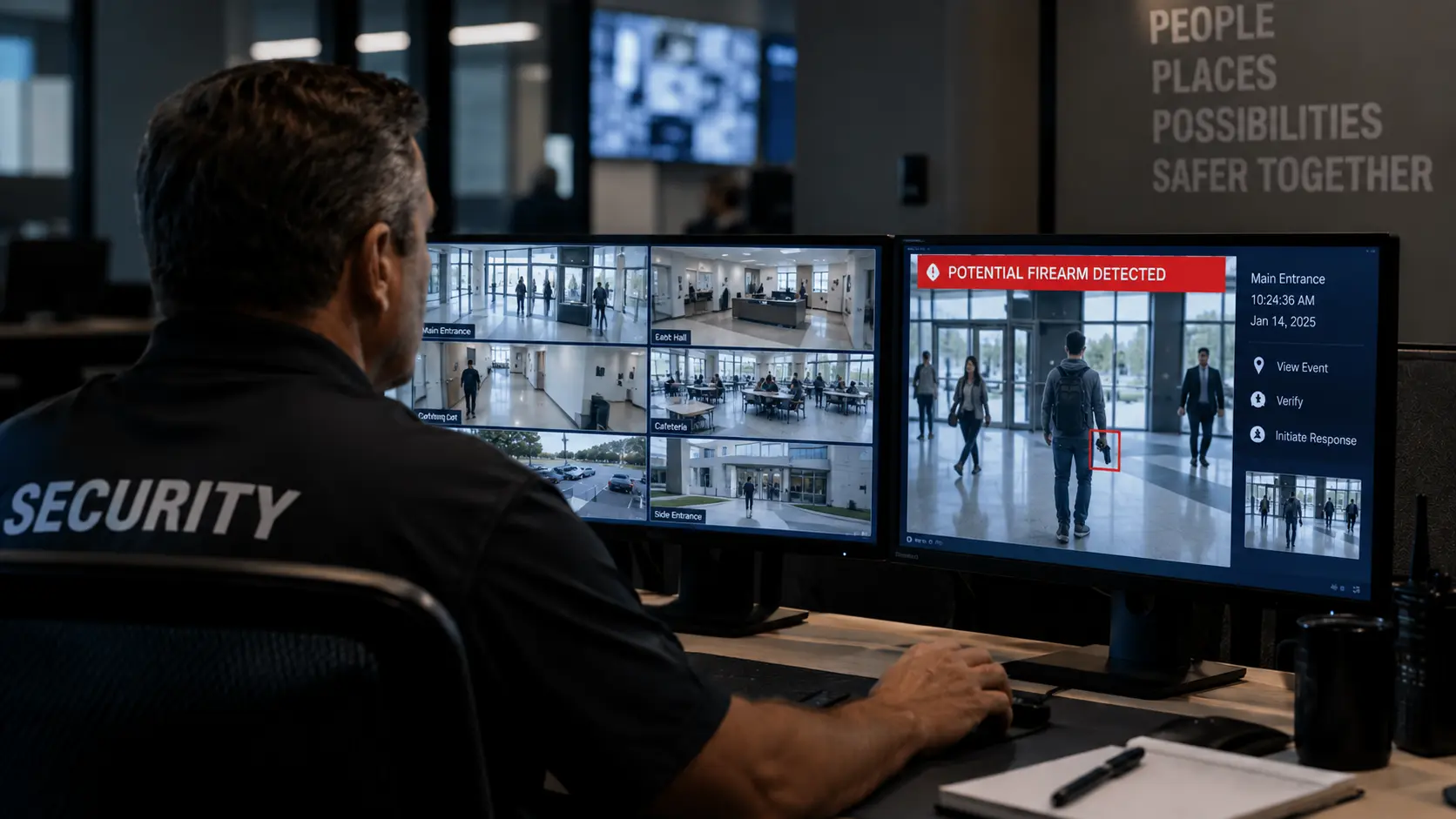
Artificial intelligence has changed what organizations can do with existing security cameras. Instead of relying solely on someone to notice a potential threat while watching a live video feed, AI gun detection can continuously analyze compatible camera streams and identify when a potential firearm becomes visible.
But identifying an object is only one part of the security challenge.
A firearm appearing on camera does not necessarily carry the same operational meaning everywhere. A visible firearm in a school hallway presents a different set of considerations than one carried by an authorized security officer at a hospital, a law enforcement officer responding to an incident, or personnel participating in a planned training exercise.
That distinction points toward an important evolution in AI gun detection: moving from detection alone toward detection informed by context.
Omnilert is approaching that challenge through a dual-AI platform that combines our firearm detection AI with intelligence tailored to individual industries and operating environments. The goal is to provide trained personnel with more useful information while maintaining human oversight and established security procedures.
What Is a Dual-AI Platform?
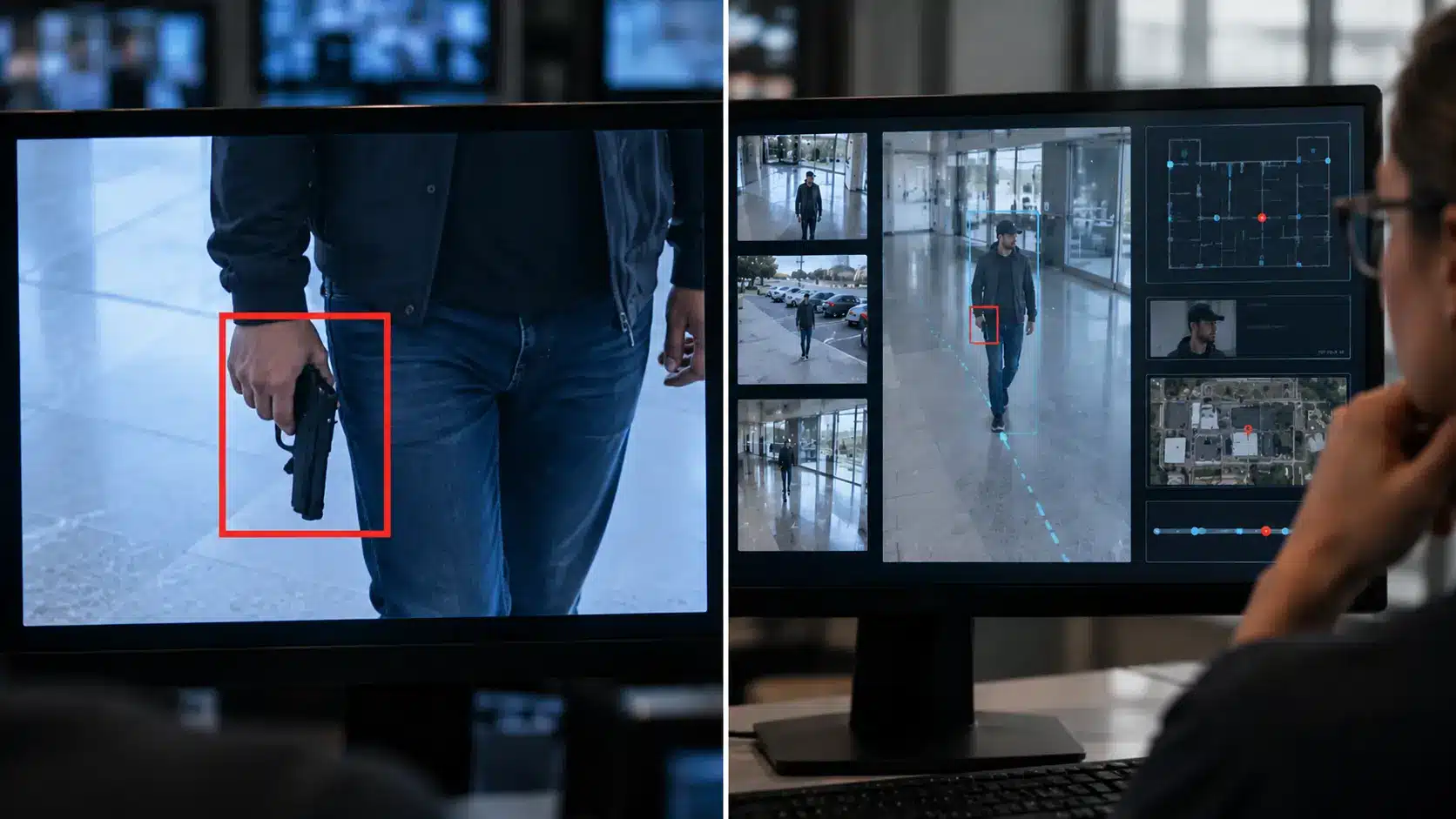
At its simplest, Omnilert’s framework separates two related security challenges: the first is identifying a potential firearm, the visual characteristics of which do not fundamentally change in different settings, and the second is understanding the environment surrounding the detection. That can vary considerably from one organization (or even one facility) to another.
Omnilert refers to these two layers as Primary Detection AI and Contextual AI:
- Primary Detection AI provides the common firearm detection capability across environments. It analyzes compatible security camera feeds and asks a relatively universal question: Is a potential firearm visible within the camera’s field of view?
- Contextual AI adds unique intelligence based on an industry’s operational realities, authorized use cases, security requirements, and individual customer environment.
Together, the two layers are designed to make a potential firearm detection more meaningful to the people responsible for evaluating and responding to it.o it.
Primary Detection AI: Creating a Common Detection Foundation
Consider the range of places where organizations use security cameras: schools, hospitals, corporate offices, manufacturing plants, transportation facilities, government buildings, stadiums, and other public venues. Their security operations can be very different. The underlying visual detection challenge, however, remains largely the same.
Organizations shouldn’t require a completely different visual detection model to identify firearms, simply because they’re a hospital or football stadium rather than a school. That’s what makes Primary Detection AI so valuable.
Omnilert’s visual firearm detection AI is a purpose-built, data-centric visual firearm detection system that analyzes compatible live security camera feeds to identify potential visible firearms across different environments. It can work with existing compatible security cameras, allowing organizations to add proactive detection capabilities without necessarily replacing their broader video infrastructure. When a possible firearm is identified, associated images, video, location information, and other event intelligence can be routed for human verification and connected with established emergency response procedures.
This creates a consistent detection foundation, but what happens around that foundation is where individual environments become increasingly important.
Why Context Matters After a Firearm Is Detected
Security teams rarely operate in environments where every appearance of a firearm has exactly the same meaning.
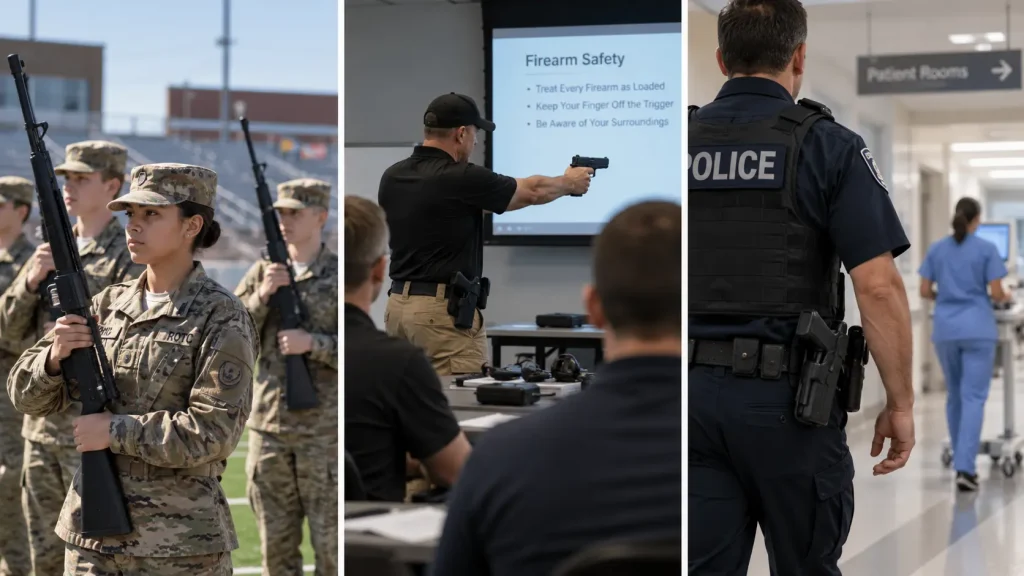
In school districts, a visible firearm could represent an immediate security concern, but the district might also have school resource officers, ROTC programs, law enforcement training activity, or other circumstances where authorized firearms could legitimately appear.
Healthcare environments have different considerations. Hospitals may regularly interact with armed law enforcement personnel or employ armed security officers. Emergency departments, patient areas, administrative offices, and parking facilities can also have different security requirements due to their varying risk levels.
Large enterprises can be more complicated still. A single organization might operate headquarters, warehouses, manufacturing facilities, distribution centers, and remote offices, each with different personnel, policies, and response procedures. The same challenge extends to transportation, government, critical infrastructure, and public venues.
This is why identifying a potential firearm answers only the first question. Security teams may also need to consider:
- What could this detection mean in this particular environment?
- Is there a known or authorized circumstance that could explain it?
- What information would help a trained reviewer assess the situation?
- Which people need to receive information about the event?
- Which established procedures should follow verification?
Omnilert’s Contextual AI framework is intended to bring this additional operational intelligence into the process without changing the underlying firearm detection capability.
Applying Context to Real-World Security Operations
The value of context becomes clearer when a potential firearm detection moves from the camera feed into an organization’s broader security operations.
Security teams already know a great deal about the environments they protect. They know which locations have armed security personnel, when training exercises are scheduled, who should be involved in different types of incidents, and which procedures apply at individual facilities. Bringing that operational knowledge into the detection process can help teams evaluate events more efficiently and respond according to established protocols.
Essentially, circumstances like training sessions or ROTC events do not change what the system is looking for, but they can change how the resulting event should be interpreted and managed.
This is where configurable capabilities become particularly useful. Organizations can establish known conditions and response requirements before an incident occurs rather than asking personnel to account for them in the moment. Omnilert’s capabilities include:
- Alert Customization, which allows organizations to establish how verified event information is distributed based on stakeholder roles, locations, and existing security procedures. Customers can configure recipient groups, determine which images, videos, and location details are shared with different audiences, and define user permissions and response controls.
- Advanced and Contextual Filters allow organizations to account for known circumstances involving authorized firearms, including armed security personnel, ROTC activities, system testing, and planned training exercises. Depending on their policies, organizations can configure these events to continue generating notifications, be suppressed, or be managed separately.
- Pause, which allows authorized users to temporarily suppress event delivery for selected cameras or locations during planned activities where firearms are expected to be visible. Customers can define the duration of the pause, while detection operations remain active across unaffected cameras and facilities.
The broader goal isn’t to teach the core detection model to overlook firearms that may be authorized. Instead, the detection layer can remain consistent while organizations apply their own operational knowledge around the event. That separation creates an important safeguard: context can influence how a detection is managed without compromising the underlying task of identifying a potential visible firearm.
Keeping Humans at the Center of Security Decisions
Adding context to AI also raises an important question: How much should the technology decide on its own?
For life-safety applications, additional intelligence should not necessarily mean removing human judgment. Omnilert’s framework is designed around human verification, with contextual information helping trained personnel evaluate an event rather than replacing their accountability.
That distinction becomes increasingly important as AI in security becomes more sophisticated.
Today, AI has the potential to identify visual information, incorporate known operating conditions, and help organize relevant event intelligence. Organizations can establish permissions, escalation logic, and response workflows in advance, but trained personnel remain central to interpreting that information and making consequential security decisions.
This combination of AI, human oversight, and predefined procedures can help organizations gain more value from automation without treating AI as an autonomous decision-maker.
From More Alerts to More Useful Information
Security teams do not always benefit from just having more information put in front of them. What actually matters is whether that information helps them understand a situation and determine what deserves their attention, or if it just creates more noise that can lead to missed events.
That is an important distinction for AI gun detection. An alert can tell a security professional that something requires review, but the reviewer still has to place that event within the realities of the environment they protect.
Building more context into the process can help close the gap between an AI-generated event and the decisions people ultimately have to make. Instead of presenting security personnel with the same type of alert regardless of circumstances, organizations can begin shaping how information is handled around their own locations, personnel, policies, and procedures.
That makes context particularly valuable for organizations with more complex security environments. A hospital system with dozens of facilities, a school district with multiple campuses, or an enterprise with offices and industrial sites may have very different conditions across its footprint. A single detection capability can serve all of them, while the surrounding security process reflects those differences.
For security teams, the evolution of AI may therefore be less about adding another layer of technology and more about making the information they already receive more relevant. The goal is to help people spend less time determining the basic circumstances of an event and more time evaluating what those circumstances mean for their organization.
Building Toward More Context-Aware Physical Security
The introduction of Omnilert’s dual-AI platform represents a broader shift in how artificial intelligence can support physical security.
Primary Detection AI provides a consistent foundation for identifying potential visible firearms, while Contextual AI analyzes the surrounding video and adds intelligence specific to the environment and customer.
Together with Alert Customization, Advanced and Contextual Filters, and Pause, these capabilities allow organizations to tailor event handling and communications around their established security requirements.
The longer-term potential extends beyond individual firearm detections. Omnilert plans to continue developing capabilities that draw additional intelligence from the visual, temporal, location, and operational context surrounding security events.
This creates a foundation for expanded contextual intelligence and future cognitive AI applications, with the goal of making security information increasingly useful before, during, and after an incident.
For organizations, the opportunity is to gain more value from existing camera infrastructure while maintaining established procedures and human oversight.
Learn more about Omnilert’s AI Gun Detection platform and how Contextual AI can support your organization’s security operations.
Frequently Asked Questions (FAQs)
What is the difference between Primary Detection AI and Contextual AI?
Primary Detection AI performs a consistent task across industries… in Omnilert’s case, identifying potential visible firearms in compatible security camera feeds. Contextual AI adds intelligence specific to an industry or customer environment, helping organizations apply relevant operational context to the detection.
Why is context important for AI gun detection?
Not every appearance of a firearm has the same operational meaning. Armed security officers, law enforcement personnel, ROTC activities, or planned training exercises are examples of circumstances that may affect how a detection should be handled. Context can give trained reviewers additional information to help them evaluate an event and follow the appropriate procedures.
Does contextual AI replace human verification?
No. Human judgment remains an important part of Omnilert’s approach. Contextual capabilities are intended to provide trained personnel with more relevant information when reviewing potential firearm events, rather than allowing AI to independently make consequential life-safety decisions.
How can organizations account for authorized firearms or planned activities?
Organizations can establish known operating conditions in advance. Omnilert capabilities such as Advanced and Contextual Filters can help manage scenarios involving authorized firearms, while Pause allows authorized users to temporarily suppress event delivery for selected cameras or locations during planned activities. The underlying firearm detection capability can remain consistent while the surrounding process reflects the organization’s requirements.